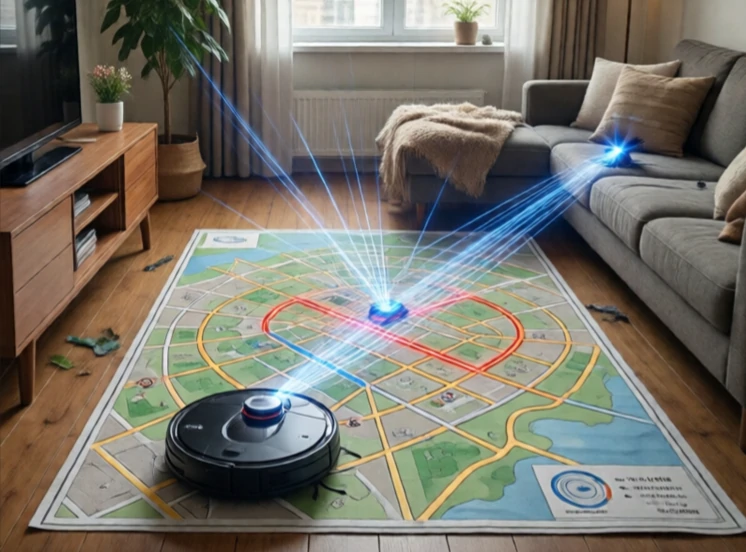
SLAM stands for Simultaneous Localization and Mapping. It solves a chicken-and-egg problem. To build a map, a robot needs to know where it is. To know where it is, the robot needs a map. SLAM does both at the same time. It is one of the foundational problems in mobile robotics.
The robot moves through an unknown environment. It collects sensor data: lidar scans, camera images, wheel odometry, IMU readings. It estimates its position and builds a map incrementally. As it revisits areas, it corrects errors in both the map and its trajectory. The result is a consistent map and a accurate path.
SLAM approaches
- EKF SLAM: extended Kalman filter, early method.
- FastSLAM: particle filter, handles landmarks.
- Graph SLAM: poses and landmarks as nodes in a graph.
- Visual SLAM: uses cameras, ORB-SLAM, LSD-SLAM.
- Lidar SLAM: uses laser scans, Gmapping, Cartographer.
SLAM is hard because errors compound. A small error in odometry grows over time. Loop closure corrects this: when the robot recognizes a place it has seen before, it closes the loop and adjusts the entire trajectory. That is why SLAM systems need robust place recognition. A change in lighting or a moved chair can break recognition. Modern SLAM systems are mature enough for commercial products. Robot vacuums use visual SLAM. Autonomous cars use lidar SLAM for mapping. SLAM is not solved, but it works well enough for many applications. The remaining challenges are dynamic environments, long-term mapping, and multi-robot SLAM.
Comments
No comments yet. Be the first to share a thought.
Leave a comment