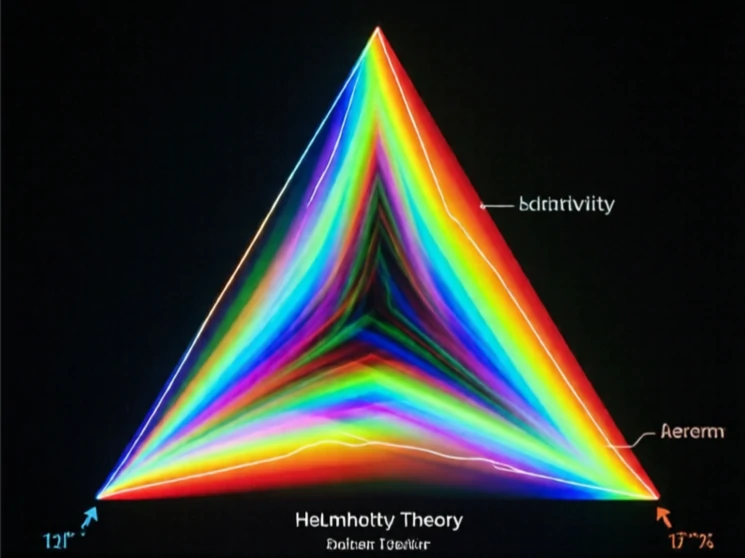
The Young-Helmholtz trichromatic theory proposes that the retina contains three types of color receptors, each most sensitive to a different range of wavelengths—roughly corresponding to red, green, and blue. All perceived colors arise from the combined activity of these three receptor types.
Thomas Young suggested the idea in the early nineteenth century; Hermann von Helmholtz developed it further. Modern physiology has confirmed the existence of three cone photopigments with peak sensitivities in the short, medium, and long wavelength regions. The brain compares the relative activation of the three cone types to construct the full range of hues. Color blindness typically results from the absence or malfunction of one cone type, altering the comparisons that produce normal color vision.
The theory accounts for the matching of any spectral color by a mixture of three primaries and for the basic facts of color mixture. It operates at the receptor level; later stages of the visual system reorganize the cone signals into opponent channels, as described by opponent-process theory. The two accounts together provide a coherent picture of color vision from retina to cortex.
Three kinds of cones, differently tuned to wavelength, are sufficient to launch the perception of a full world of color.
Comments
No comments yet. Be the first to share a thought.
Leave a comment