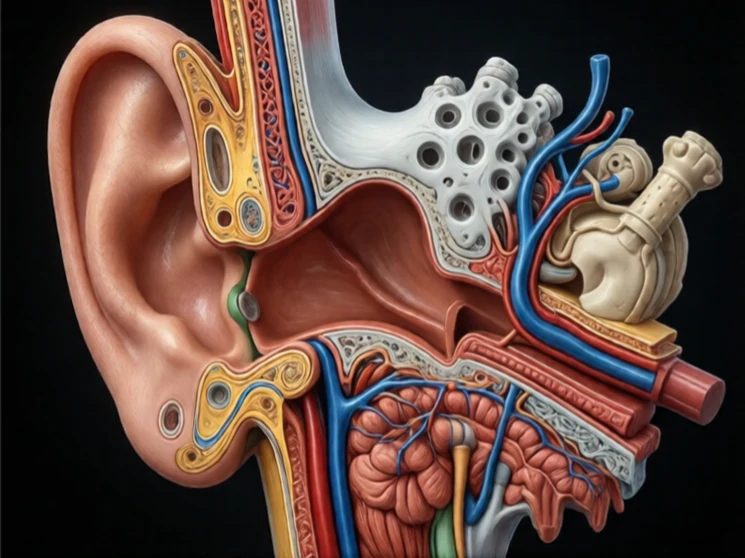
The inner ear is the innermost portion of the auditory system. It contains the cochlea, which transduces sound, and the vestibular organs, which sense balance and head movement.
Sound vibrations reaching the inner ear set the fluid of the cochlea in motion. Hair cells along the basilar membrane convert that motion into neural signals that travel via the auditory nerve to the brain. The semicircular canals and otolith organs detect rotational and linear acceleration, providing the information needed for balance and spatial orientation. Both systems share the same fluid-filled, membranous architecture and the same hair-cell transduction mechanism.
Damage to the inner ear produces sensorineural hearing loss or vestibular disorders such as vertigo. Because the structures are delicate and encased in bone, diagnosis often relies on functional tests and imaging rather than direct inspection. Cochlear implants bypass damaged hair cells by stimulating the auditory nerve directly, restoring a form of hearing to many people with severe inner-ear loss.
The inner ear is where mechanical vibration becomes the electrical language of the nervous system.
Comments
No comments yet. Be the first to share a thought.
Leave a comment