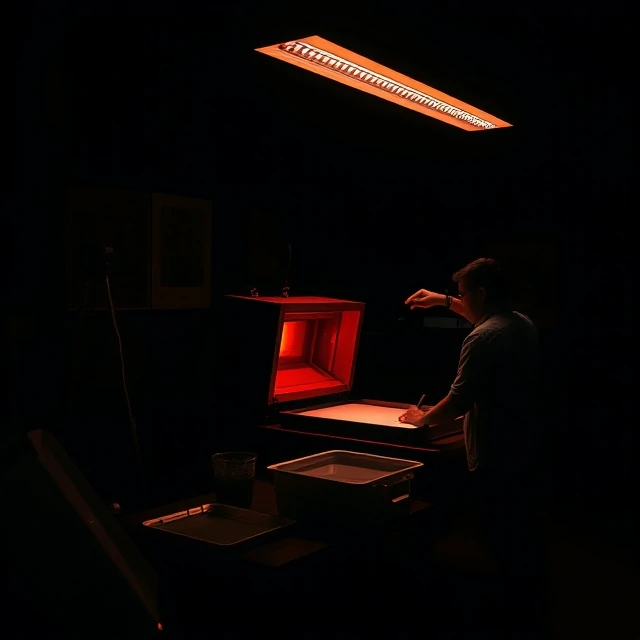
A darkroom is a room for processing film and making prints. It is dark because light would ruin the film and paper. The work happens under safelight, a dim red or amber lamp that does not affect black-and-white materials. The room has a sink, chemical trays, an enlarger, and a light-tight door. It smells of fixer and developer. It is a place of quiet, methodical work.
The process has not changed much in a century. Film is loaded into a developing tank, often in total darkness. Developer, stop bath, and fixer are poured in and out at timed intervals. The film is washed and dried, then cut into strips. To make a print, the negative is placed in an enlarger, which projects light through it onto photographic paper. The paper is exposed, then developed, stopped, fixed, washed, and dried. Each step affects the final image. Contrast, exposure, and dodging and burning are all controlled by hand. Digital photography has replaced much of this work, but darkrooms remain in use. Some photographers prefer the craft. Others teach it to understand the roots of the medium.
Darkroom equipment
- Enlarger. Projects the negative onto paper.
- Developing tank. Holds film during processing.
- Chemical trays. Hold developer, stop, and fixer.
- Safelight. Provides dim light that does not expose paper.
- Print dryer. Dries finished prints.
The darkroom is slow. That slowness is part of its appeal.
Comments
No comments yet. Be the first to share a thought.
Leave a comment