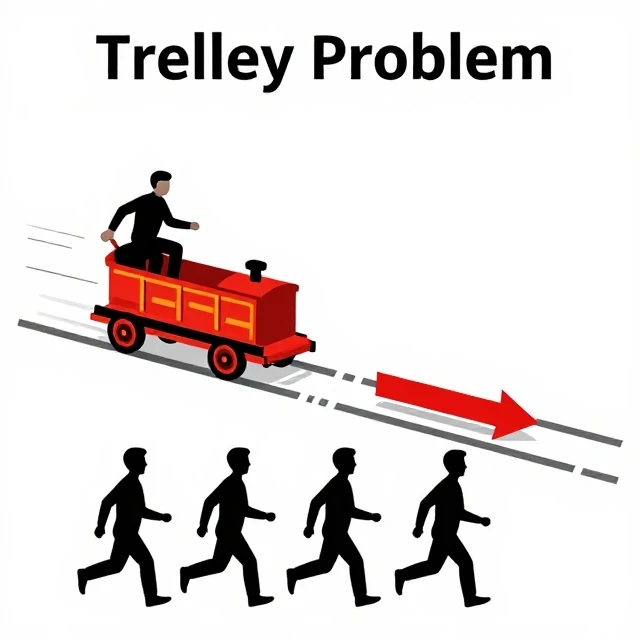
A thought experiment is an imaginary scenario used to explore philosophical ideas. It is a test case. It isolates a variable. It asks: what would we say if? The scenario is hypothetical. The intuitions are real. Thought experiments have been used since ancient Greece. They are a tool of philosophy, science, and ethics.
Some thought experiments are famous. The trolley problem asks whether you would divert a runaway trolley to kill one person instead of five. The ship of Theseus asks whether a ship remains the same after all its planks are replaced. The brain in a vat asks whether you can know anything about the external world. Each one isolates a problem. Each one provokes intuition.
Famous thought experiments
- Trolley problem: sacrificing one to save many.
- Ship of Theseus: identity and change.
- Brain in a vat: knowledge and reality.
- Veil of ignorance: fairness and justice.
- Chinese room: artificial intelligence and understanding.
- Mary's room: consciousness and color.
Thought experiments are not experiments. They do not test hypotheses. They test concepts. They reveal hidden assumptions. They clarify intuitions. They are not always reliable. Intuitions can conflict. Different people have different intuitions. The trolley problem divides people. Some say divert. Some say do not. The thought experiment does not give an answer. It maps the moral landscape. That is its value. It is a tool for thinking. It is not a substitute for evidence. But it is a way to explore what we believe and why. A good thought experiment is simple. It is memorable. It is unsettling. It stays with you. It makes you think.
Comments
No comments yet. Be the first to share a thought.
Leave a comment