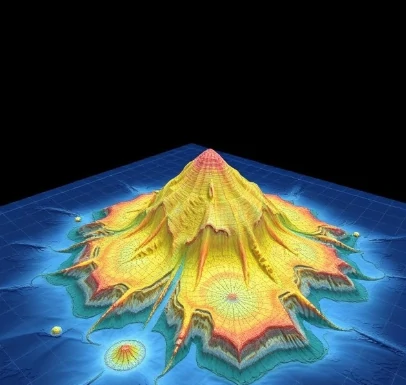
Any mountain that rises from the seafloor but does not reach the surface is a seamount. Most are volcanic in origin, formed at mid-ocean ridges, hotspots, or subduction-related arcs. Their summits may lie a few hundred meters or several thousand meters below sea level.
Seamounts interrupt currents, creating localized upwelling and accelerated flows that deliver food to suspension feeders. As a result they often host dense and diverse communities of corals, sponges, and associated fishes, making them biodiversity hotspots in otherwise sparse deep-sea landscapes. Many seamounts are also targets for fisheries that pursue the aggregating fish.
Because seamounts are isolated and slow-growing communities can take centuries to recover from disturbance, they are a focus of conservation concern. Only a small fraction of the estimated tens of thousands of seamounts have been sampled biologically. Improved bathymetric mapping continues to reveal new seamounts across the global ocean.
- Underwater mountain that does not reach the surface
- Usually volcanic in origin
- Supports enhanced biodiversity
- Vulnerable to fishing impacts
Comments
No comments yet. Be the first to share a thought.
Leave a comment