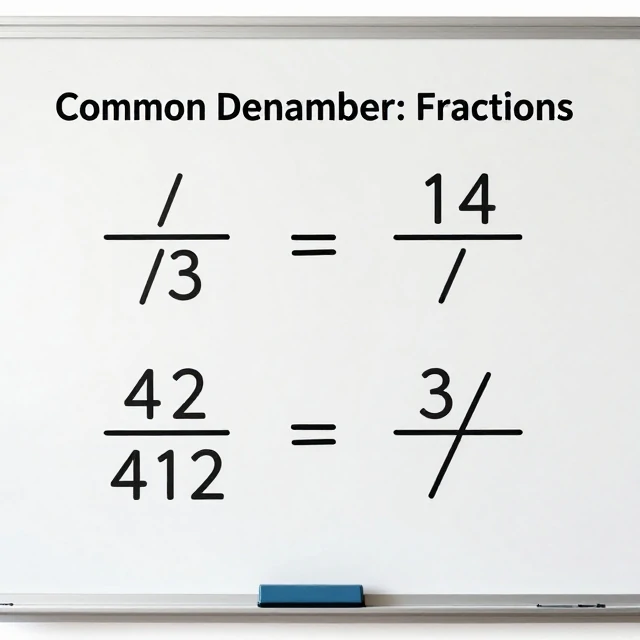
A common denominator is a shared multiple of the denominators of two or more fractions. It is needed to add or subtract fractions. The fractions must have the same denominator before the numerators can be combined. Find the least common multiple of the denominators and use that as the common denominator.
For 1/3 and 1/4, the denominators are 3 and 4. The least common multiple is 12. Convert both fractions: 1/3 becomes 4/12, and 1/4 becomes 3/12. Add the numerators: 4 + 3 = 7. The sum is 7/12. The common denominator makes the addition possible.
Finding a common denominator
- List multiples of each denominator.
- Find the smallest multiple they share.
- Convert each fraction to an equivalent fraction with that denominator.
- Add or subtract the numerators.
- Simplify the result if possible.
The least common denominator is the smallest common denominator. It keeps the numbers manageable. You can use any common denominator, but larger numbers are harder to work with. For 1/6 and 1/8, the least common multiple is 24. The product is 48. Both work. But 24 keeps the fractions simpler. Finding the least common multiple is a skill that pays off in algebra. When adding rational expressions, the same process applies. The denominators are polynomials. Factoring helps find the least common denominator. The principle is the same. You cannot add fractions until the denominators match. The common denominator is the bridge that makes addition possible.
Comments
No comments yet. Be the first to share a thought.
Leave a comment