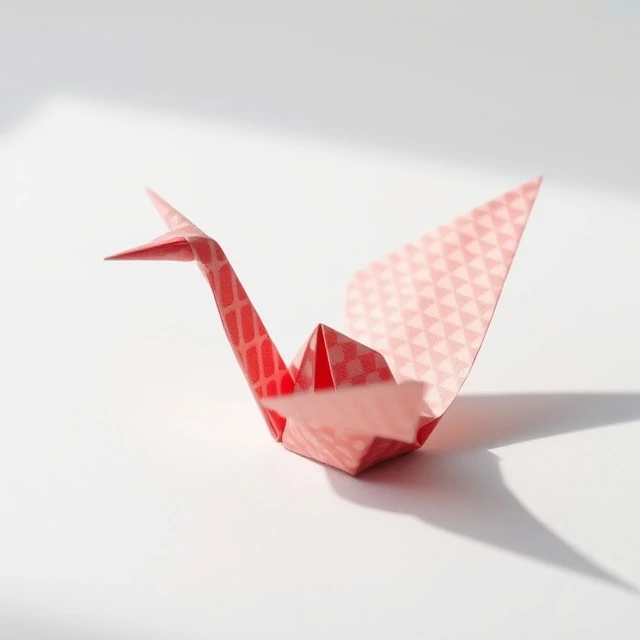
Origami folds a flat sheet of paper into a finished shape without cutting or gluing. The word comes from Japanese: oru, to fold, and kami, paper. A square is the standard starting point. From that square, a few hundred folds can produce a crane, a frog, a dragon, or a complex geometric form. The paper does all the work. Creases become structural lines.
Traditional models like the crane, the boat, and the water bomb have been passed down for centuries. Modern origami, driven by folders like Akira Yoshizawa and Satoshi Kamiya, pushes into wet-folding, tessellations, and ultra-complex insects with hundreds of steps. Some designers use mathematical crease patterns to invent new forms. Others fold from uncut squares only, following the strictest tradition.
Useful starting folds
- Valley fold — paper folds toward you, like a book closing
- Mountain fold — paper folds away from you
- Preliminary base — a square base used in many traditional models
- Water bomb base — a triangular base for balloons and cranes
Thin paper works best for complex models. Kami, tant, and tissue foil all hold a crease well. Copy paper is too thick for anything beyond simple shapes.
Comments (2)
Leave a comment