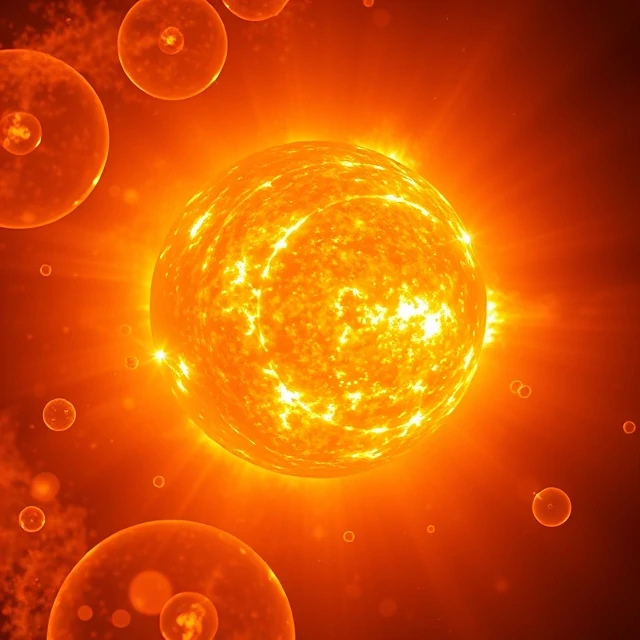
The sun shines because of nuclear fusion. In its core, hydrogen nuclei combine to form helium, releasing enormous amounts of energy. Fusion is the process of merging light atomic nuclei into heavier ones. It releases energy because the total mass of the products is less than the mass of the original nuclei. The missing mass becomes energy, following E = mc². Fusion powers stars and produces the elements that make up planets and life. It is the ultimate source of most energy on Earth, from sunlight to fossil fuels.
Fusion is difficult to achieve on Earth. It requires temperatures of millions of degrees and immense pressure to overcome the electric repulsion between nuclei. In stars, gravity provides the pressure. On Earth, researchers use magnetic confinement or inertial confinement. Magnetic confinement uses powerful magnetic fields to hold plasma in a tokamak. Inertial confinement uses lasers to compress a tiny fuel pellet. The goal is to achieve ignition, where the fusion reaction produces more energy than it consumes. In 2022, the National Ignition Facility achieved ignition for the first time. Fusion produces no long-lived radioactive waste and no greenhouse gases. It is the holy grail of clean energy, but it remains decades away from commercial use.
Fusion facts
- Definition. Merging light nuclei.
- Fuel. Hydrogen isotopes, deuterium and tritium.
- Requirements. Extreme temperature and pressure.
- Energy. E = mc², mass converted to energy.
- Applications. Stars, experimental reactors.
Nuclear fusion is not the same as nuclear fission. Fusion combines light nuclei. Fission splits heavy nuclei.
Comments
No comments yet. Be the first to share a thought.
Leave a comment