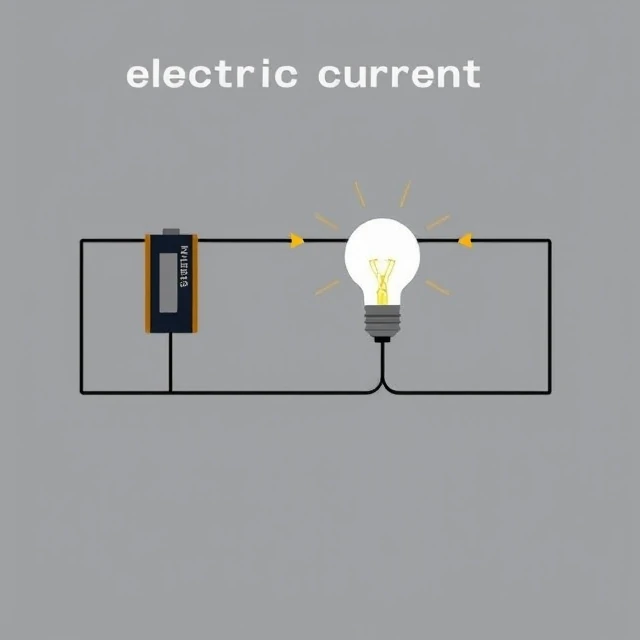
Flip a switch and lights come on. Electrons flow through the wires, carrying energy from the power plant to your home. That flow is electric current, the rate at which electric charge moves past a point. It is measured in amperes, or amps. One amp is one coulomb of charge per second. Current flows from the negative terminal to the positive terminal in a circuit, though conventional current is defined as flowing from positive to negative. The difference is a historical convention, and it does not affect circuit analysis.
Current comes in two forms. Direct current, or DC, flows in one direction. Batteries produce DC. Alternating current, or AC, reverses direction many times per second. Power grids use AC because it is easy to transform between voltages. In the United States, AC reverses 60 times per second. In Europe, it is 50. Current is carried by free electrons in metals, by ions in solutions, and by holes and electrons in semiconductors. Ohm's law relates current to voltage and resistance. Higher voltage pushes more current. Higher resistance reduces it.
Current facts
- Definition. Rate of flow of electric charge.
- Unit. Ampere (A).
- DC. Direct current, one direction.
- AC. Alternating current, reverses direction.
- Ohm's law. Current equals voltage divided by resistance.
Current is not the same as voltage. Voltage is the push. Current is the flow. Resistance is the opposition.
Comments
No comments yet. Be the first to share a thought.
Leave a comment