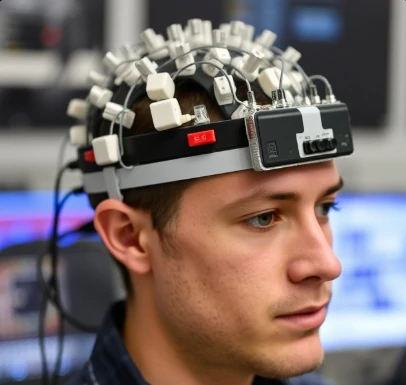
Electrodes placed on the scalp can detect the summed electrical activity of large populations of neurons. The resulting record is the electroencephalogram, or EEG. Rhythmic patterns in the EEG change with arousal, attention, sleep stage, and certain pathological states.
Because the method is noninvasive and has millisecond temporal resolution, it is widely used to study sensory processing, cognitive operations, and the dynamics of sleep. Clinically, EEG is essential for diagnosing epilepsy, monitoring depth of anesthesia, and evaluating disorders of consciousness.
Different frequency bands—delta, theta, alpha, beta, gamma—have been associated with distinct functional states, although the relationships are complex. Source-localization techniques attempt to infer the location of generators from the scalp distribution, with varying success. Combined with behavioral tasks or other imaging modalities, EEG remains a cornerstone of both basic and clinical neuroscience.
- Records summed electrical activity from the scalp
- High temporal resolution
- Used in sleep, cognition, and epilepsy studies
- Noninvasive and relatively inexpensive
Comments
No comments yet. Be the first to share a thought.
Leave a comment