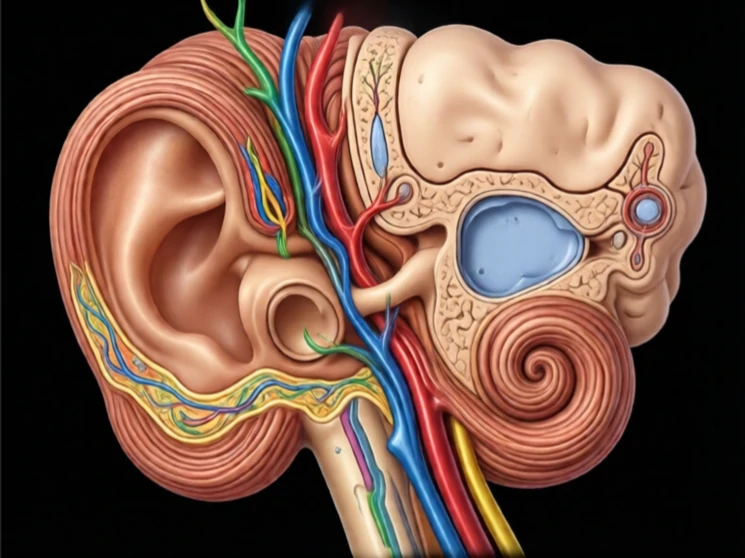
The vestibular sense provides information about the position and movement of the head and, by extension, the orientation of the body in space. It is essential for balance, posture, and the stabilization of gaze.
The receptors lie in the inner ear: the semicircular canals detect rotational acceleration, and the otolith organs detect linear acceleration and the pull of gravity. Signals travel via the vestibular nerve to brainstem nuclei that coordinate eye movements, postural adjustments, and conscious perception of orientation. The system works in close partnership with vision and proprioception; conflicts among the three can produce motion sickness.
Damage or dysfunction of the vestibular apparatus causes vertigo, imbalance, and difficulty stabilizing the visual world during head movement. Vestibular rehabilitation can help the nervous system adapt to permanent loss. The sense operates continuously and largely outside awareness until something goes wrong.
Knowing which way is up and detecting a sudden turn both depend on the vestibular sense.
Comments
No comments yet. Be the first to share a thought.
Leave a comment