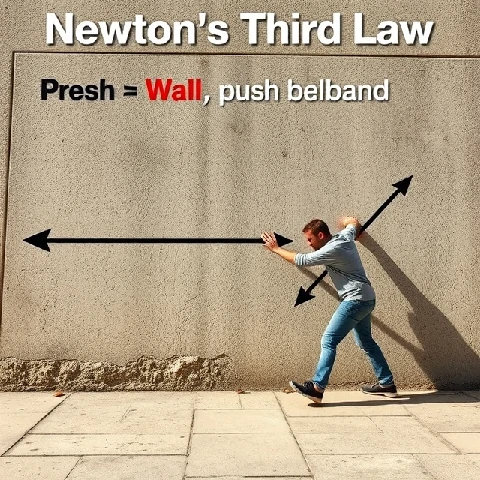
Push against a wall and the wall pushes back. That is Newton's third law: for every action, there is an equal and opposite reaction. The forces come in pairs. They act on different objects. They are equal in magnitude and opposite in direction. The law is simple, but it is often misunderstood. The action and reaction forces do not cancel each other out, because they act on different objects. If you push a box, your hand pushes the box and the box pushes your hand. The box moves because the force you exert on it is greater than the friction acting on it. Your hand does not move because your body is braced against the ground.
The third law explains many everyday phenomena. When you walk, you push backward on the ground and the ground pushes you forward. When a rocket expels exhaust downward, the exhaust pushes the rocket upward. When a bird flies, its wings push air downward and the air pushes the bird upward. When a gun fires, the bullet moves forward and the gun recoils backward. The third law is also why collisions conserve momentum. The forces between two colliding objects are equal and opposite, so the momentum changes are equal and opposite. The total momentum stays the same.
Key points
- Equal and opposite. Forces come in pairs.
- Different objects. Action and reaction act on different objects.
- Do not cancel. They do not cancel because they act on different objects.
- Examples. Walking, rockets, birds, guns.
- Momentum. Explains conservation of momentum.
Newton's third law is not the same as the second law. The second law relates force to acceleration. The third law relates forces between objects.
Comments
No comments yet. Be the first to share a thought.
Leave a comment