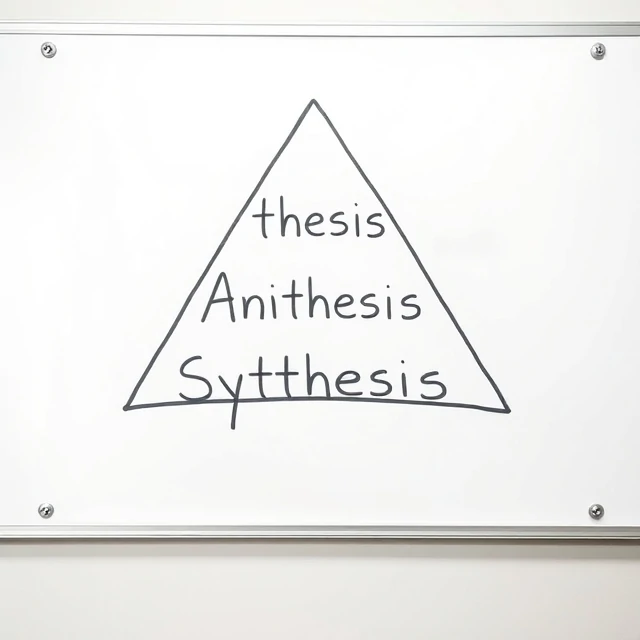
In dialectic, synthesis is the resolution of a conflict between thesis and antithesis. The thesis is a claim. The antithesis is its opposite. The synthesis is a new position that incorporates what is valid in both. Hegel is associated with this pattern, though he did not use the terms systematically. His followers did, and the pattern became a staple of philosophical and political thought. The synthesis is not a compromise. It is not halfway between the two. It is a higher-level position that preserves the insights of both while overcoming their limitations.
In chemistry, synthesis is the combination of simpler substances into a more complex one. In writing, synthesis is the integration of ideas from multiple sources into a coherent whole. In philosophy, synthesis is a method of resolving contradictions. Kant used the term in his Critique of Pure Reason, arguing that knowledge requires a synthesis of concepts and intuitions. Fichte, Schelling, and Hegel developed the dialectical sense. Marx applied it to history, arguing that class conflict drives social change. The synthesis is not the end of the process. It becomes a new thesis, and the dialectic continues. Synthesis is a way of thinking that seeks unity without erasing difference.
Uses of synthesis
- Dialectical. Resolving thesis and antithesis.
- Chemical. Building complex molecules from simple ones.
- Academic. Integrating ideas from multiple sources.
- Kantian. Combining concepts and intuitions in knowledge.
Synthesis is not the same as compromise. Compromise splits the difference. Synthesis transforms the terms of the debate.
Comments
No comments yet. Be the first to share a thought.
Leave a comment