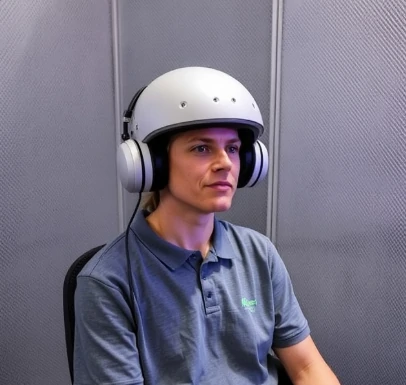
Electrical currents in neurons generate tiny magnetic fields that pass through the skull essentially undistorted. Magnetoencephalography, or MEG, records those fields with sensitive superconducting detectors arrayed around the head, providing a direct measure of neural activity with millisecond precision.
Because magnetic fields are less smeared by the skull than electric potentials, MEG offers better spatial localization than EEG for many sources, especially those that are tangential to the scalp. The method is silent and does not involve radiation or strong magnetic fields that would interfere with other equipment, making it suitable for studies of development and of patients with implants.
MEG is used to map sensory and language areas before surgery, to study the timing of cognitive processes, and to investigate oscillatory dynamics in health and disease. Combining MEG with structural MRI allows the measured fields to be projected onto the individual’s cortical surface. The main practical constraints are cost and the need for a magnetically shielded room.
- Records magnetic fields from neural currents
- High temporal resolution
- Good localization for tangential sources
- Used in clinical mapping and cognitive research
Comments
No comments yet. Be the first to share a thought.
Leave a comment