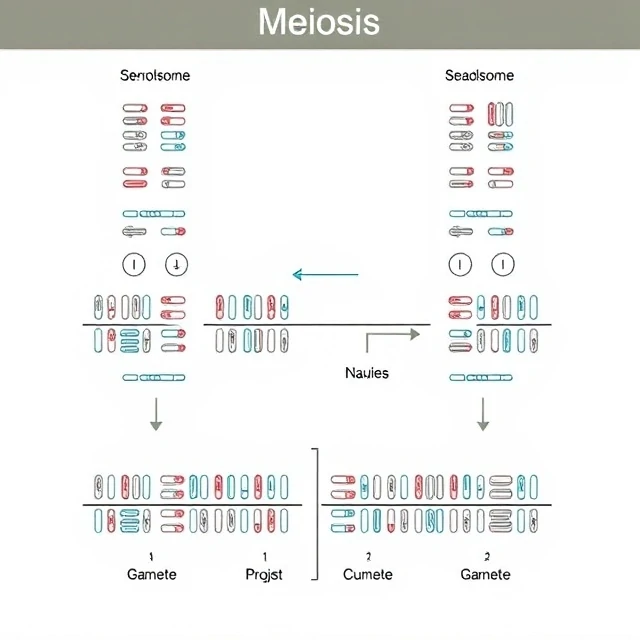
Each individual carries two alleles for a given gene, yet gametes receive only one. The law of segregation states that the two alleles separate cleanly during gamete formation so that each gamete obtains exactly one allele. Fertilization then restores the pair.
Mendel deduced the law from monohybrid crosses that produced consistent 3:1 phenotypic ratios in the second generation. The cytological basis is the separation of homologous chromosomes during anaphase I of meiosis. Sister chromatids later separate in meiosis II.
Segregation ensures that genetic information is transmitted in a predictable, particulate manner rather than by blending. Exceptions such as nondisjunction produce aneuploidy. The principle remains a cornerstone of classical genetics and underpins risk calculations in genetic counseling.
- Alleles separate during gamete formation
- Each gamete receives one allele
- Explains 3:1 ratios in monohybrid crosses
- Based on homologous chromosome separation
Comments (2)
Leave a comment