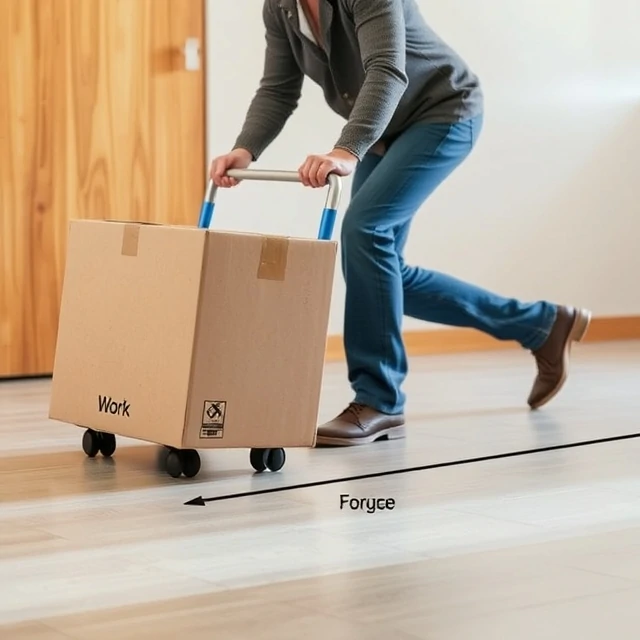
In physics, work has a precise meaning. It is the transfer of energy when a force moves an object. If you push a box across the floor, you do work on the box. If you hold a heavy box without moving it, you do no work on it, no matter how tired you feel. Work is calculated as force times distance times the cosine of the angle between them. W = Fd cosθ. The unit of work is the joule. One joule is the work done by a one-newton force moving an object one meter in the direction of the force.
Work is closely related to energy. When work is done on an object, its energy changes. The work-energy theorem says that the net work done on an object equals its change in kinetic energy. If you push a stationary box and it starts moving, you have done work and increased its kinetic energy. If friction acts against the motion, it does negative work and decreases kinetic energy. Work can also change potential energy. Lifting a box does work against gravity and increases the box's gravitational potential energy. Work is not always positive. It can be negative, as when friction slows an object down. Work is one of the most fundamental concepts in mechanics, linking force, motion, and energy.
Work facts
- Definition. Transfer of energy by force over distance.
- Formula. W = Fd cosθ.
- Unit. Joule (J).
- Work-energy theorem. Net work equals change in kinetic energy.
- Negative work. Force opposes motion.
Work is not the same as power. Work is the energy transferred. Power is the rate at which work is done.
Comments
No comments yet. Be the first to share a thought.
Leave a comment