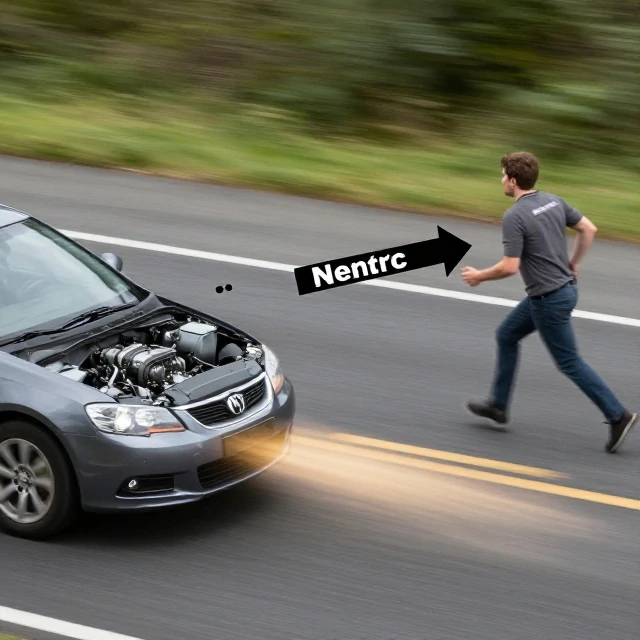
Net force is the vector sum of all forces acting on an object. It determines the acceleration. If the net force is zero, the object does not accelerate. If the net force is nonzero, the object accelerates in the direction of the net force. Newton's second law says force equals mass times acceleration. The force in that equation is the net force.
Forces are vectors. They have magnitude and direction. To find the net force, add them as vectors. Two forces in the same direction add. Two forces in opposite directions subtract. Forces at an angle require trigonometry. A free-body diagram helps. Draw the object. Draw every force acting on it. Then add them.
Finding net force
- Identify all forces acting on the object.
- Draw a free-body diagram.
- Resolve forces into components.
- Add components along each axis.
- The vector sum is the net force.
Net force is not the same as any single force. A car has an engine force pushing forward and friction pushing backward. The net force is the difference. If the engine force is greater, the car accelerates. If friction is greater, the car slows. If they are equal, the car moves at constant speed. The net force is what changes motion. It does not matter how many forces act. It matters what they add up to. A thousand forces can cancel to zero. Two forces can produce a large net force. The net force is the bottom line. It is the single force that would produce the same acceleration as all the individual forces combined.
Comments
No comments yet. Be the first to share a thought.
Leave a comment