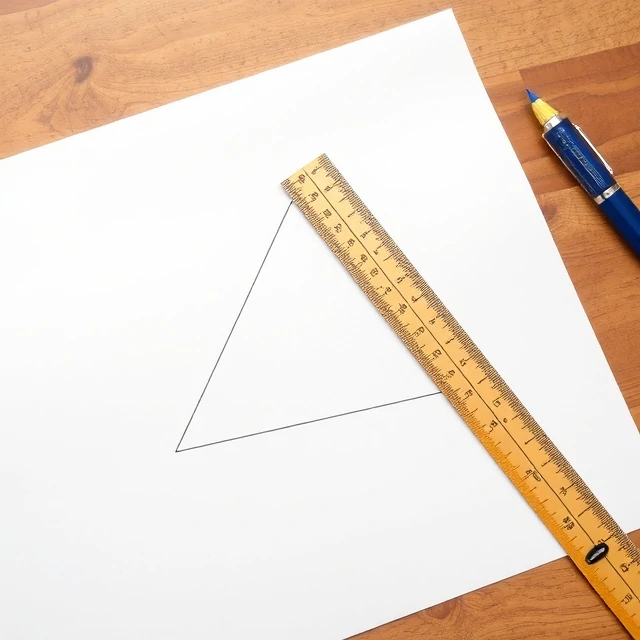
Two rays leaving the same point create an angle. The point is the vertex; the rays are the sides. Angles measure the amount of turn between the sides, usually in degrees or radians. A full circle is 360 degrees, a straight line 180, and a right angle 90.
Angles appear everywhere: the corner of a room, the tilt of a roof, the spread of a pair of scissors. In geometry, they classify triangles (acute, right, obtuse) and drive the rules of parallel lines and polygons. Two angles that add to 90 degrees are complementary; those adding to 180 are supplementary.
Navigation, surveying, and astronomy depend on precise angle measurement. Sailors take bearings, surveyors turn theodolites, and astronomers measure the separation of stars. Even a clock's hands form angles that change minute by minute. The concept is simple to state and endlessly useful.
- Formed by two rays sharing a vertex
- Measured in degrees or radians
- Right angle is 90 degrees
- Central to geometry, navigation, and surveying
Comments
No comments yet. Be the first to share a thought.
Leave a comment