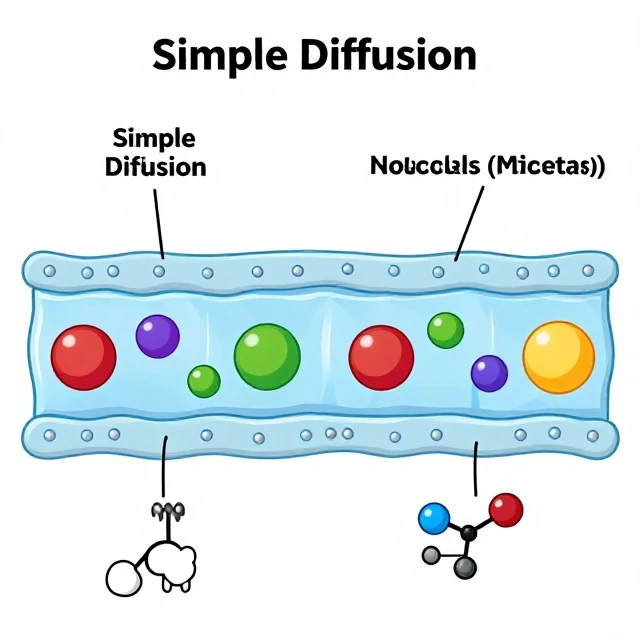
Simple diffusion is the movement of molecules from high concentration to low concentration without energy input. It is passive. The molecules move randomly. The net effect is a flow from crowded regions to empty ones. Eventually the concentration equalizes. That is equilibrium.
Oxygen enters cells by simple diffusion. Carbon dioxide leaves. Small, nonpolar molecules pass through the lipid bilayer easily. Water passes slowly, though aquaporins speed it up. Large or charged molecules cannot cross by simple diffusion. They need channels or transporters.
Simple diffusion characteristics
- Passive: no ATP required.
- Down the concentration gradient.
- Rate proportional to concentration difference.
- Rate depends on temperature and molecule size.
- Not saturable: no transporter involved.
Fick's law describes the rate. It depends on the concentration gradient, the surface area, and the permeability of the membrane. A steeper gradient diffuses faster. A larger surface area diffuses more. A thicker membrane diffuses less. Lungs maximize surface area for oxygen diffusion. Kidneys maximize surface area for filtration. The principle is the same. Diffusion is slow over long distances. A molecule takes a fraction of a second to cross a cell membrane. It takes hours to diffuse across a room. That is why organisms use circulation and convection to move substances over long distances. Simple diffusion is the foundation of transport. It is passive, random, and relentless. It never stops until equilibrium is reached.
Comments
No comments yet. Be the first to share a thought.
Leave a comment