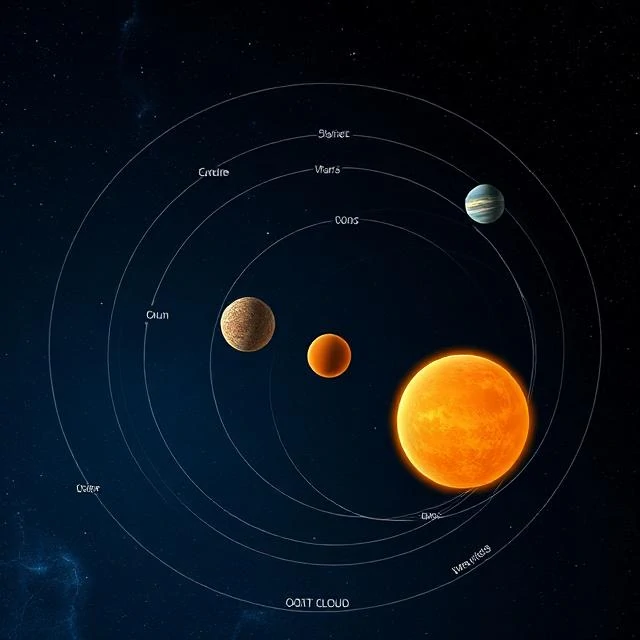
Far beyond the Kuiper Belt, at the outermost edge of the solar system, lies the Oort Cloud. It is a spherical shell of icy bodies that extends from about 2,000 to 100,000 astronomical units from the Sun. It has never been directly observed. Its existence is inferred from the orbits of long-period comets, which come from all directions rather than clustering near the ecliptic.
The Dutch astronomer Jan Oort proposed the cloud in 1950 to explain why long-period comets appear from random directions. The cloud is thought to contain billions or trillions of icy objects, left over from the formation of the solar system. They formed closer to the Sun but were flung outward by gravitational interactions with the giant planets.
The Oort Cloud is not stable. Passing stars and the Milky Way's gravity nudge objects out of their orbits, sending some inward toward the Sun. Those become the long-period comets we see. Others are ejected from the solar system entirely, becoming rogue objects drifting through interstellar space.
No spacecraft has visited the Oort Cloud. At its distance, even a fast probe would take centuries to arrive. It remains one of the solar system's last unexplored frontiers.
Comments
No comments yet. Be the first to share a thought.
Leave a comment