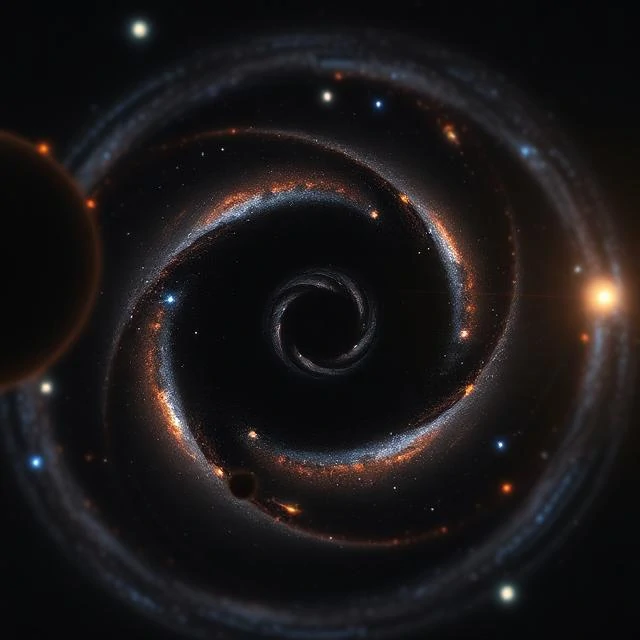
Mass bends light. That is a prediction of Einstein's general relativity, and it has been confirmed many times. When a massive object like a galaxy or cluster sits between a distant source and an observer, its gravity bends the light from the source. The result is a magnified, distorted, or multiple image of the source. That is gravitational lensing.
There are three types. Strong lensing produces obvious arcs, rings, and multiple images. It happens when the alignment is nearly perfect and the mass is large. Weak lensing produces subtle distortions in the shapes of background galaxies. It is used to map dark matter. Microlensing produces a brief brightening of a star when a compact object passes in front of it. It is used to find exoplanets and black holes.
Lensing is a tool, not just a curiosity. It lets astronomers see galaxies that would otherwise be too faint. It maps the distribution of dark matter. It measures the Hubble constant. It even tests general relativity in extreme conditions.
The first lensed quasar was discovered in 1979. Since then, thousands of lenses have been found. The James Webb Space Telescope is finding more, including some of the earliest galaxies in the universe.
Comments (2)
Leave a comment