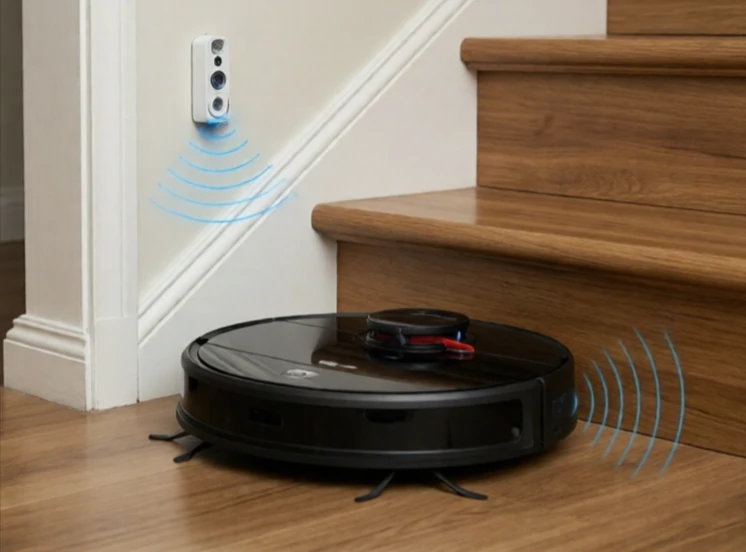
An ultrasonic sensor measures distance with sound. It emits a high-frequency pulse, waits for the echo, and times the round trip. Divide by the speed of sound and divide by two, and you have the distance. Ultrasonic sensors work in air, water, and some solids. They are cheap, robust, and unaffected by lighting.
The technology is similar to sonar. A transducer generates the pulse and receives the echo. The frequency is above human hearing, typically 40 kHz. The sensor outputs a signal proportional to distance. Some sensors have separate transmit and receive transducers. Others use a single transducer that switches between modes.
Ultrasonic sensor characteristics
- Range: a few centimeters to several meters.
- Beam width: wide, which limits angular resolution.
- Update rate: slower than infrared or lidar.
- Affected by temperature, humidity, and wind.
- Poor at detecting soft, angled, or small objects.
Ultrasonic sensors are common on mobile robots for obstacle detection. They are inexpensive and reliable in indoor environments. A robot vacuum uses ultrasonic sensors to avoid stairs and walls. A car uses them for parking assist. The wide beam is both an advantage and a disadvantage. It detects obstacles over a broad area, but it cannot tell exactly where the obstacle is. That makes it good for safety stops but poor for mapping. Ultrasonic sensors are often paired with infrared or lidar. The infrared sensor provides a narrow beam for precise detection. The ultrasonic sensor provides a wide beam for safety. Together they cover more ground than either alone.
Comments
No comments yet. Be the first to share a thought.
Leave a comment