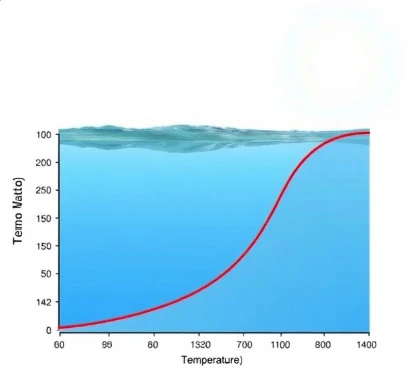
Seawater density is the mass contained in a unit volume and is controlled primarily by temperature and salinity, with a smaller effect from pressure. Cold, salty water is denser than warm, fresh water. Even small density differences, on the order of tenths of a kilogram per cubic meter, are enough to drive the large-scale circulation of the ocean.
Oceanographers calculate density from precise measurements of temperature, salinity, and pressure using internationally accepted equations of state. Density surfaces, rather than depth surfaces, are the natural framework for understanding how water masses move and mix. Vertical density stratification determines how easily the water column can be mixed by winds or internal waves.
In polar regions, cooling and ice formation increase density until water sinks. In the subtropics, evaporation raises salinity and density at the surface. These regional density modifications ultimately power the global thermohaline circulation. Accurate density determination is therefore central to both observational and modeling studies of the ocean.
A difference of only one part in a thousand in density can separate distinct water masses that remain distinct for decades.
Comments
No comments yet. Be the first to share a thought.
Leave a comment