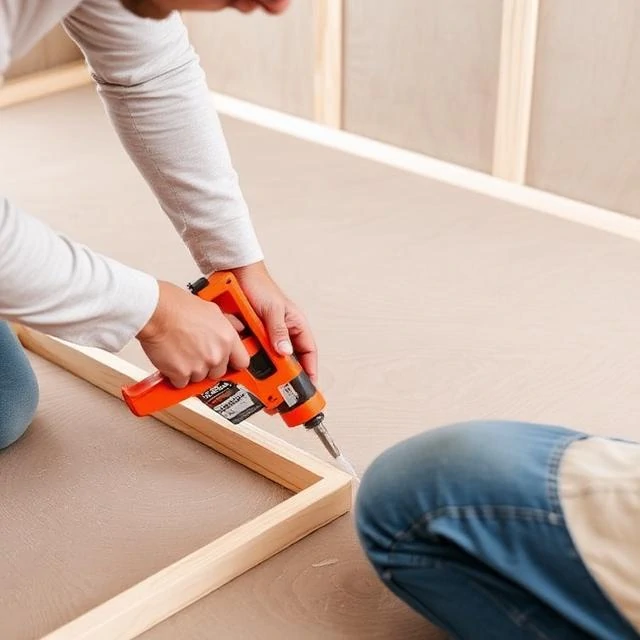
Nails and screws are not the only way to hold things together. Adhesives bond materials using chemical or physical forces. They spread across a surface, fill the microscopic gaps, and harden to create a continuous connection. Construction adhesives hold drywall to studs, subfloor to joists, and countertops to cabinets. They distribute stress across the entire joint rather than concentrating it at fastener points. That is why a glued joint can be stronger than a nailed one.
Adhesives come in many chemistries. Polyurethane adhesives bond wood, metal, and concrete, and they expand slightly as they cure. Epoxy is a two-part adhesive that forms a rigid, high-strength bond. Construction adhesive, sold in caulking tubes, is a thick mastic for framing and panels. Contact cement bonds instantly when two coated surfaces touch. Each has its own open time, cure time, and gap-filling ability.
Surface preparation matters more than the adhesive itself. Dust, oil, and moisture weaken the bond. Some adhesives need clamping. Some need moisture to cure. Some cure only in thin films. A failed adhesive joint usually fails at the interface, not in the adhesive. That is why manufacturers specify the substrate, the temperature, and the method. Read the label, or the bond will not hold.
Comments
No comments yet. Be the first to share a thought.
Leave a comment