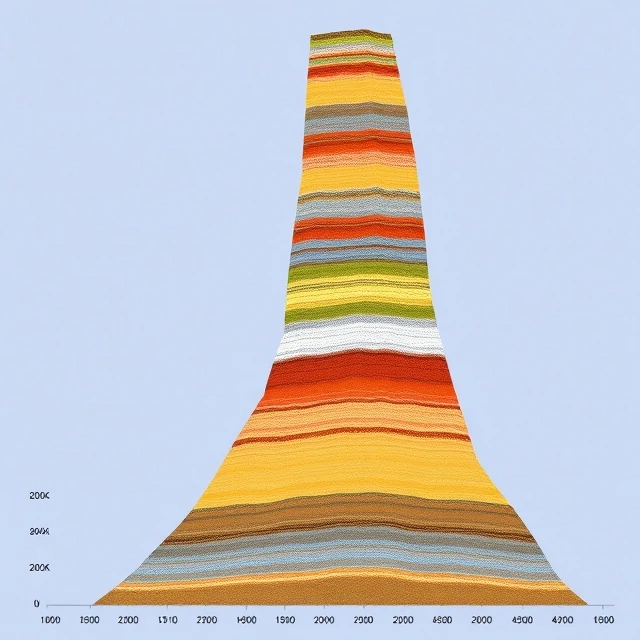
Layered rocks contain a sequential record of events. Stratigraphy is the study of rock layers, their order, distribution, and correlation. It provides the temporal framework for almost all of historical geology and paleontology.
Lithostratigraphy classifies units by rock type; biostratigraphy uses fossils; chronostratigraphy seeks time equivalence. Sequence stratigraphy interprets packages of strata in terms of sea-level change and sediment supply. Principles such as superposition, original horizontality, and cross-cutting relationships guide interpretation.
Stratigraphic columns and correlation charts summarize the relationships among units across a region. Radiometric dating and magnetostratigraphy add numerical ages. Accurate stratigraphy underpins resource exploration, geologic mapping, and the reconstruction of Earth’s environmental history.
- Study of rock layers and their order
- Uses lithology, fossils, and numerical ages
- Provides the time framework for geology
- Essential for correlation and mapping
Comments
No comments yet. Be the first to share a thought.
Leave a comment