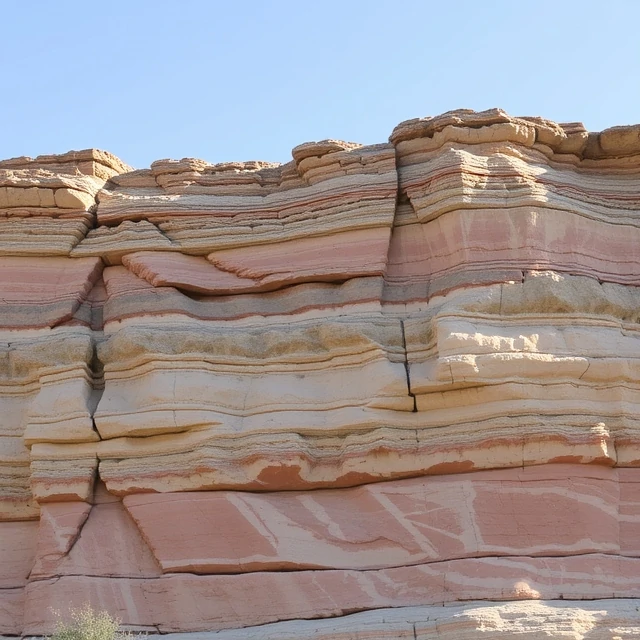
Particles that settle and become cemented form sedimentary rock. These rocks cover much of the continents in a relatively thin veneer and preserve the most complete record of surface conditions through time. They are classified as clastic, chemical, or organic according to origin.
Sandstone, shale, and conglomerate are common clastic types. Limestone and evaporites form by chemical or biochemical processes. Coal is an organic sedimentary rock. Bedding, fossils, and sedimentary structures are characteristic features that distinguish them from igneous and metamorphic rocks.
Sedimentary rocks host most of the world’s petroleum, natural gas, coal, and groundwater. They also contain the fossil record that documents the history of life. Interpreting depositional environments from sedimentary rocks is a core skill in historical geology and resource exploration.
- Rock formed from accumulated sediment
- Clastic, chemical, or organic in origin
- Typically bedded and may contain fossils
- Hosts major energy and water resources
Comments
No comments yet. Be the first to share a thought.
Leave a comment