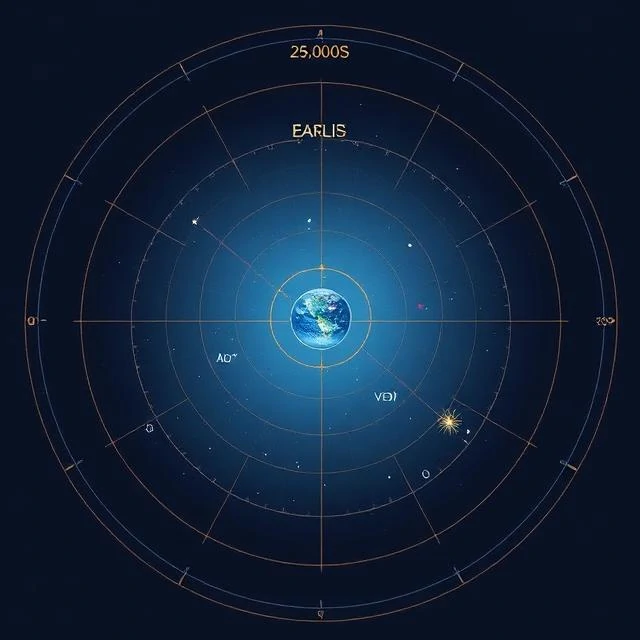
Earth's axis wobbles like a spinning top that is slowing down. The wobble is called precession, and it takes about 26,000 years to complete one cycle. It happens because the Sun and Moon pull on Earth's equatorial bulge, trying to straighten the tilt. Earth resists, and the axis slowly traces a circle in the sky.
The consequences are visible over long timescales. The north celestial pole currently points near Polaris, the North Star. In 12,000 years, it will point near Vega. The equinoxes, where the Sun crosses the celestial equator, drift westward along the ecliptic. That drift is why the zodiac signs no longer align with the constellations they were named for.
Precession also affects the climate. The changing orientation of Earth's axis alters the distribution of sunlight across the seasons. This is one of the Milankovitch cycles that pace the ice ages. The effect is small in any given year, but over thousands of years it can shift the timing and intensity of seasons enough to trigger glacial advances.
Ancient astronomers noticed precession. Hipparchus compared star positions from his time to those recorded by Babylonian astronomers and found a shift. He estimated the rate with surprising accuracy, considering he had no telescope.
Comments (2)
Leave a comment