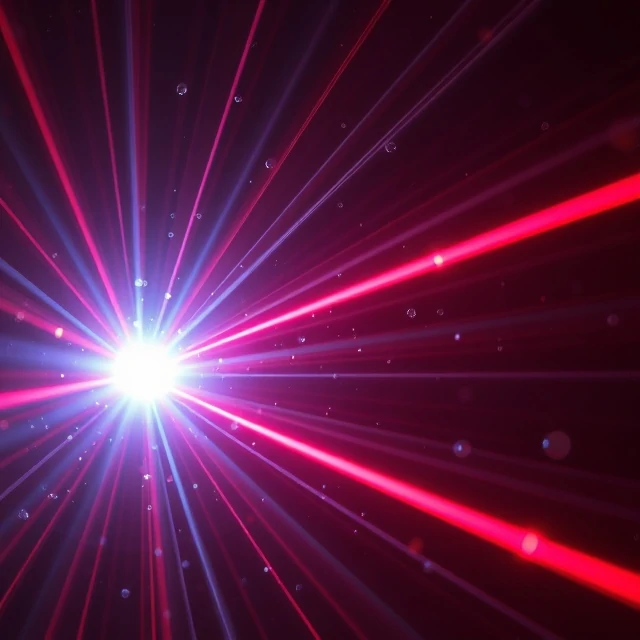
A photon is a particle of light. It has no mass, no electric charge, and it always travels at the speed of light in a vacuum. Photons carry electromagnetic energy, and the amount of energy depends on their frequency. A high-frequency photon, like a gamma ray, carries more energy than a low-frequency photon, like a radio wave. Photons are the force carriers of electromagnetism. When two charged particles interact, they exchange photons. That exchange is what we call the electromagnetic force.
Photons behave as both particles and waves. In some experiments, they interfere with themselves like waves. In others, they strike detectors like particles. That duality is one of the central mysteries of quantum mechanics. The concept of the photon was introduced by Einstein in 1905, in his explanation of the photoelectric effect. He proposed that light comes in discrete packets of energy, which we now call photons. That work earned him the Nobel Prize in Physics in 1921. Photons are used in lasers, solar cells, and quantum computing. They are also the messengers of the universe, carrying information from distant stars to our telescopes.
Photon facts
- Definition. Particle of light.
- Mass. Zero.
- Speed. Always c in a vacuum.
- Energy. E = hf, where h is Planck's constant.
- Force carrier. Mediates electromagnetism.
A photon is not the same as an electron. An electron has mass and charge. A photon has neither.
Comments
No comments yet. Be the first to share a thought.
Leave a comment