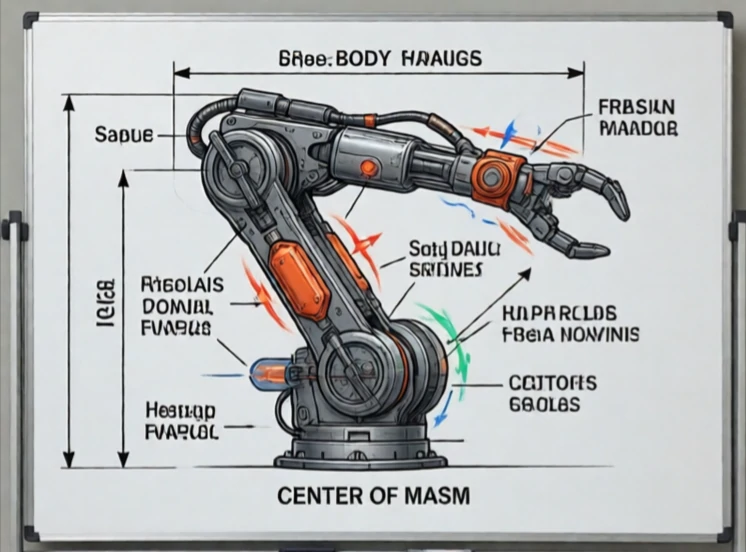
Dynamics studies forces and their effects on motion. In robotics, it answers the question: what torque does each joint need to produce a desired acceleration? Kinematics describes where the robot goes. Dynamics describes what it takes to get there.
The equations of motion for a robot are complex. They include inertia, Coriolis forces, centrifugal forces, gravity, and friction. A robot arm moving fast experiences different forces than one moving slowly. A humanoid robot has to account for the momentum of every limb. Solving these equations in real time is a computational challenge.
Why dynamics matter
- Accurate torque control requires a dynamics model.
- Fast movements need feedforward compensation.
- Lightweight robots reduce inertial forces.
- Gravity compensation makes arms feel weightless.
- Simulation relies on dynamic models for realism.
Model-based control uses the dynamic equations to compute the torque needed for a desired motion. That feedforward term handles most of the work. Feedback corrects for modeling errors and disturbances. Without dynamics, a robot can still move slowly using position control. Push it to high speed and it will lag, oscillate, or overshoot. Dynamics is the physics of motion, and ignoring it limits what a robot can do. The best robot designers think about dynamics from the first sketch, not as an afterthought.
Comments
No comments yet. Be the first to share a thought.
Leave a comment