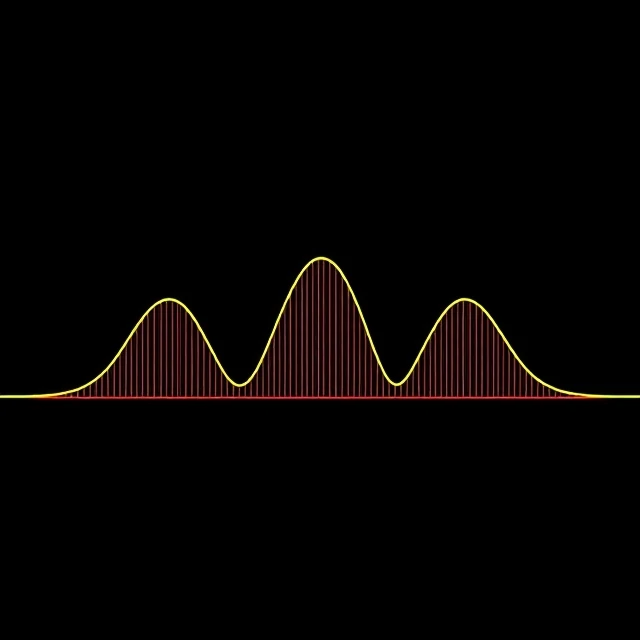
Wavelength is the distance between successive peaks of a wave. It is usually measured in meters, but for light it is often measured in nanometers. Visible light has wavelengths from about 400 to 700 nanometers. Red light has the longest wavelength, around 700 nanometers. Violet light has the shortest, around 400 nanometers. Radio waves have wavelengths from meters to kilometers. Gamma rays have wavelengths less than a picometer. Wavelength is inversely related to frequency. The shorter the wavelength, the higher the frequency. The relationship is described by v = fλ, where v is wave speed, f is frequency, and λ is wavelength.
Wavelength determines many properties of waves. In light, wavelength determines color. In sound, wavelength determines pitch. In radio, wavelength determines the channel. Wavelength also affects how waves interact with objects. A wave diffracts around obstacles comparable to its wavelength. A wave reflects off surfaces larger than its wavelength. That is why radio waves can travel around buildings, but light waves cannot. Wavelength is a fundamental property of waves. It is one of the key parameters that describe a wave, along with frequency, amplitude, and speed. It is used in physics, engineering, and astronomy. It is also used in everyday life, from microwave ovens to radio tuners.
Wavelength facts
- Definition. Distance between successive peaks.
- Units. Meters, nanometers.
- Visible light. 400 to 700 nm.
- Relation. Inversely proportional to frequency.
- Equation. v = fλ.
Wavelength is not the same as frequency. Wavelength is distance. Frequency is cycles per second.
Comments
No comments yet. Be the first to share a thought.
Leave a comment