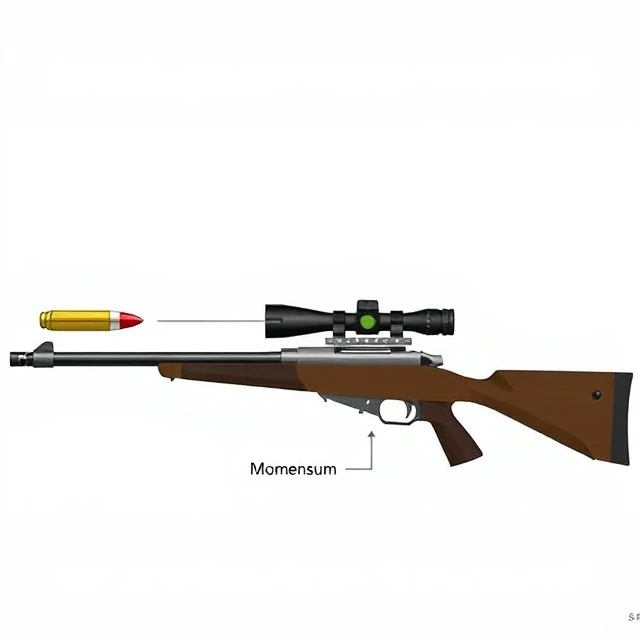
Fire a rifle and the rifle kicks back. The bullet moves forward, the rifle moves backward, and the total momentum stays the same. That is the conservation of momentum. In a closed system, with no external forces, the total momentum of all objects remains constant. Momentum is mass times velocity, and it is a vector, so direction matters. A collision between two billiard balls conserves momentum. A rocket expelling exhaust conserves momentum. The exhaust goes one way, the rocket goes the other.
Momentum conservation follows from Newton's third law. When two objects interact, they exert equal and opposite forces on each other for the same amount of time. That means they receive equal and opposite impulses, which means their momentum changes are equal and opposite. The total momentum does not change. The law holds in classical mechanics and in relativity, where momentum is redefined to include a relativistic factor. It also holds in quantum mechanics, where momentum is an operator and conservation is tied to the symmetry of space. Noether's theorem connects conservation laws to symmetries, and momentum conservation comes from the fact that space looks the same everywhere.
Momentum conservation facts
- Definition. Total momentum in a closed system is constant.
- Vector. Direction matters.
- Newton's third law. Equal and opposite forces conserve momentum.
- Noether's theorem. Conservation follows from symmetry of space.
Momentum is not the same as energy. Both are conserved, but they are different quantities with different units.
Comments
No comments yet. Be the first to share a thought.
Leave a comment