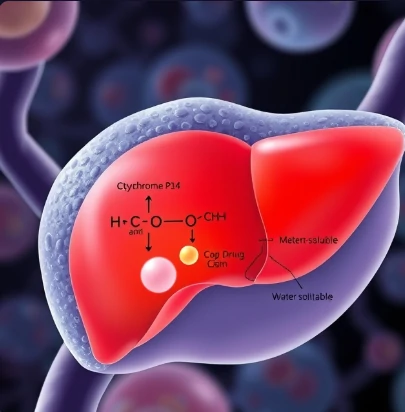
The body treats drugs as foreign chemicals and tries to get rid of them. Metabolism is the process of chemically modifying those drugs, usually to make them more water-soluble so they can be excreted. The liver does most of the work, using enzymes to add or remove chemical groups. Sometimes metabolism activates a drug that was given in an inactive form. Sometimes it produces a metabolite that is toxic. Most of the time, it simply prepares the drug for elimination.
The cytochrome P450 family is the most important group of drug-metabolizing enzymes. These enzymes handle a large fraction of prescription drugs. Genetic variations in these enzymes explain why some people metabolize drugs quickly and others slowly. A poor metabolizer may experience stronger effects from a standard dose, while an ultrarapid metabolizer may clear the drug before it can work. Drug interactions often involve one drug inhibiting or inducing a P450 enzyme, changing the metabolism of another drug. Grapefruit juice inhibits CYP3A4, for example, which can raise levels of statins and other drugs.
Metabolism phases:
- Phase I. Oxidation, reduction, and hydrolysis, often by cytochrome P450.
- Phase II. Conjugation with glucuronic acid, sulfate, or other groups to increase solubility.
- Prodrug activation. Some drugs require metabolism to become active.
- Toxic metabolites. Some drugs produce reactive metabolites that can damage the liver.
Metabolism and excretion together determine how long a drug stays in the body.
Comments
No comments yet. Be the first to share a thought.
Leave a comment