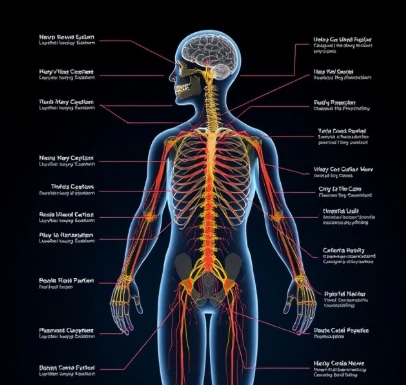
The nervous system is the body’s electrochemical communication network. It takes in information from the environment and from the body itself, processes that information, and issues commands that control movement, glands, and internal organs.
It is divided into the central nervous system—the brain and spinal cord—and the peripheral nervous system, which includes all the nerves that extend to the rest of the body. The peripheral system further divides into sensory pathways that carry information inward and motor pathways that carry commands outward. The autonomic branch regulates involuntary functions and itself splits into sympathetic and parasympathetic divisions that prepare the body for action or for rest.
Neurons are the primary signaling cells; glial cells support, protect, and modulate their activity. Communication occurs through electrical impulses within neurons and chemical transmission between them. Damage or disease anywhere in the network can disrupt sensation, movement, cognition, or physiological regulation.
Every perception, thought, and action depends on the continuous activity of the nervous system.
Comments (3)
Leave a comment