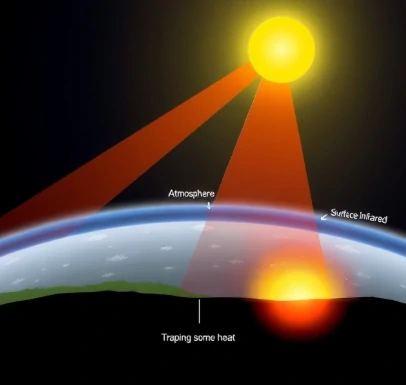
Sunlight warms Earth’s surface. The surface then radiates infrared energy upward. Certain gases in the atmosphere absorb a portion of that infrared radiation and re-emit it in all directions, including back toward the ground. The resulting warming is the greenhouse effect.
Without this natural process, the planet’s average temperature would be well below freezing. Water vapor, carbon dioxide, methane, and other gases all contribute. Human activities have increased the concentrations of several of these gases, strengthening the effect and raising global temperatures.
The name comes from the analogous trapping of heat inside a glass greenhouse, although the physical mechanisms differ in detail. Climate models simulate the effect by calculating the absorption and emission of radiation at each wavelength and height.
Understanding the greenhouse effect is fundamental to explaining both the current climate and its recent changes.
Comments
No comments yet. Be the first to share a thought.
Leave a comment