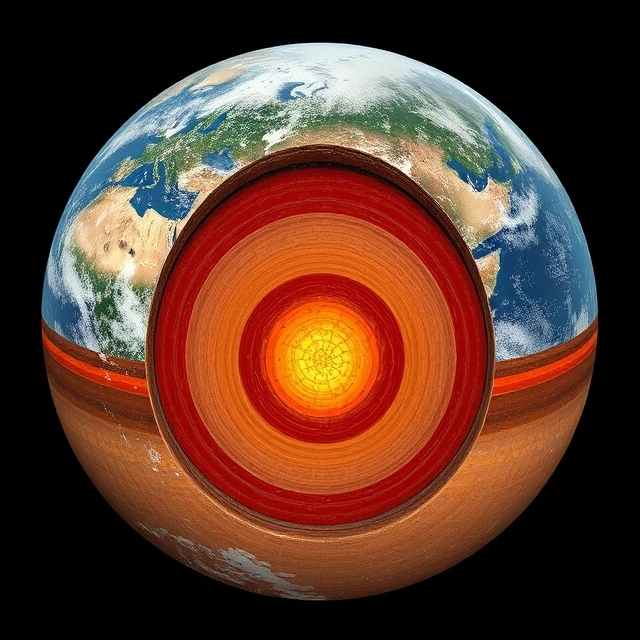
Between the thin crust and the metallic core lies the thick rocky mantle. It extends from the base of the crust to a depth of about 2,900 km and makes up roughly two-thirds of Earth’s mass. Although solid, the mantle convects slowly over geologic time.
Composition is dominated by silicate minerals rich in magnesium and iron. Pressure and temperature increase with depth, producing phase transitions that appear as seismic discontinuities. The upper mantle includes the rigid lithospheric mantle and the ductile asthenosphere; the lower mantle is denser and flows more sluggishly.
Mantle convection drives plate tectonics and delivers heat from the deep interior to the surface. Plumes rising from the deep mantle are thought to feed hotspot volcanoes. Almost all of the mantle remains inaccessible to direct sampling except through rare xenoliths and the interpretation of seismic waves.
- Thick rocky layer between crust and core
- Solid but convects over long timescales
- Source of basaltic magmas
- Drives plate tectonic motion
Comments
No comments yet. Be the first to share a thought.
Leave a comment