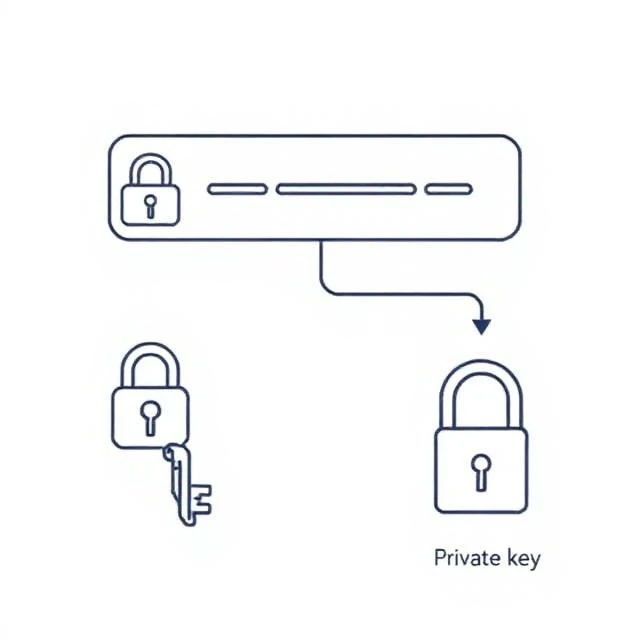
Asymmetric encryption uses two keys instead of one. A public key encrypts. A private key decrypts. The public key can be shared with anyone. The private key stays secret. That asymmetry solves a problem that symmetric encryption cannot: how do two parties who have never met agree on a secret key without an eavesdropper learning it?
RSA and elliptic curve cryptography are the common algorithms. When you visit a website over HTTPS, your browser uses the site's public key to establish a secure channel. Only the site's private key can decrypt what the browser sends. The same math runs in digital signatures, email encryption, and cryptocurrency wallets. It is slower than symmetric encryption, which is why most systems use both. Asymmetric encryption handles the key exchange. Symmetric encryption handles the bulk data. The two work together in a hybrid scheme, and that scheme secures most of the internet.
Asymmetric vs symmetric
- Asymmetric — two keys, slower, solves key distribution
- Symmetric — one shared key, faster, needs a secure channel to share it
- Hybrid — asymmetric for key exchange, symmetric for data
- Common algorithms — RSA, ECC, Diffie-Hellman
Weak key sizes are the usual failure point. A 512-bit RSA key is trivially breakable today. Use current recommendations and rotate keys when algorithms age out.
Comments
No comments yet. Be the first to share a thought.
Leave a comment