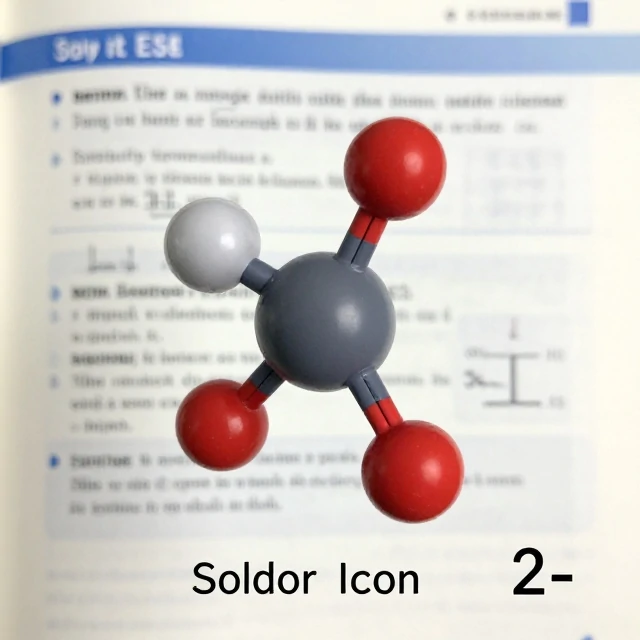
A polyatomic ion is a charged group of two or more atoms bonded together. The atoms share electrons covalently, but the group as a whole has a net charge. It behaves as a single unit in chemical reactions. The sulfate ion, SO4 2-, is a polyatomic ion. So is the ammonium ion, NH4+.
The atoms in a polyatomic ion stay together. They do not dissociate in solution. When sodium sulfate dissolves in water, it separates into Na+ and SO4 2-. The sulfate ion remains intact. The bonds between sulfur and oxygen are covalent. The charge comes from an excess or deficiency of electrons in the group.
Common polyatomic ions
- Nitrate: NO3-.
- Sulfate: SO4 2-.
- Carbonate: CO3 2-.
- Phosphate: PO4 3-.
- Ammonium: NH4+.
- Hydroxide: OH-.
Naming follows patterns. Ions ending in -ate have more oxygen. Ions ending in -ite have less oxygen. Nitrate is NO3-. Nitrite is NO2-. Per- and hypo- prefixes indicate more or fewer oxygen atoms. Chlorate is ClO3-. Perchlorate is ClO4-. Hypochlorite is ClO-. Learning the common polyatomic ions is essential in chemistry. They appear in acids, bases, salts, and buffers. They determine solubility, reactivity, and biological function. The carbonate buffer system keeps blood pH stable. The phosphate backbone holds DNA together. Polyatomic ions are small, but they are everywhere.
Comments
No comments yet. Be the first to share a thought.
Leave a comment