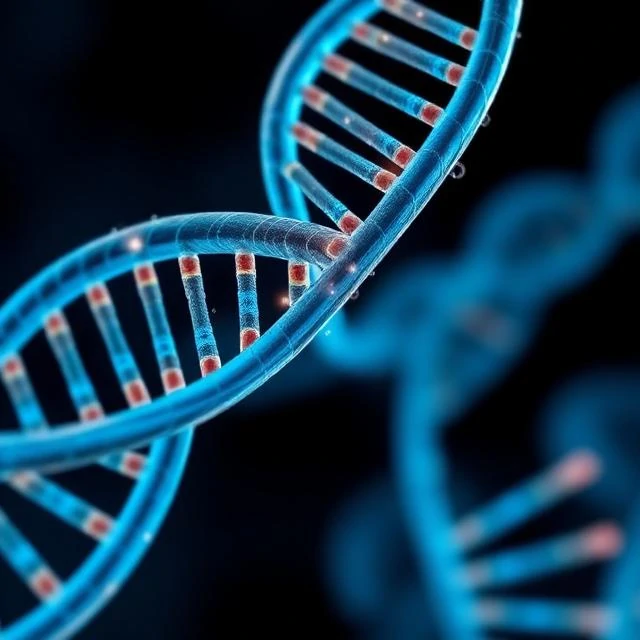
DNA and RNA are nucleic acids, biopolymers that carry genetic information. They are made of nucleotides, each consisting of a sugar, a phosphate group, and a nitrogenous base. DNA has deoxyribose and the bases adenine, thymine, guanine, and cytosine. RNA has ribose and uracil instead of thymine. The sequence of bases encodes the information.
DNA is a double helix, with two strands held together by hydrogen bonds between complementary bases. Adenine pairs with thymine. Guanine pairs with cytosine. The sequence of one strand determines the sequence of the other. That is how genetic information is copied and transmitted. RNA is usually single-stranded and performs many functions: messenger RNA carries the code, transfer RNA brings amino acids, ribosomal RNA forms the ribosome, and regulatory RNAs control gene expression.
Nucleic acids were discovered in 1869 by Friedrich Miescher, but their role in heredity was not established until the 1940s and 1950s. The double helix structure was solved in 1953 by James Watson and Francis Crick, using X-ray diffraction data from Rosalind Franklin and Maurice Wilkins. That discovery launched the era of molecular biology.
Nucleic acids are used in medicine, forensics, and biotechnology. DNA sequencing diagnoses disease, identifies individuals, and traces ancestry. PCR amplifies DNA for analysis. CRISPR edits genes. mRNA vaccines instruct cells to produce antigens. The nucleic acid is the molecule of life and the tool of biotechnology.
Comments
No comments yet. Be the first to share a thought.
Leave a comment