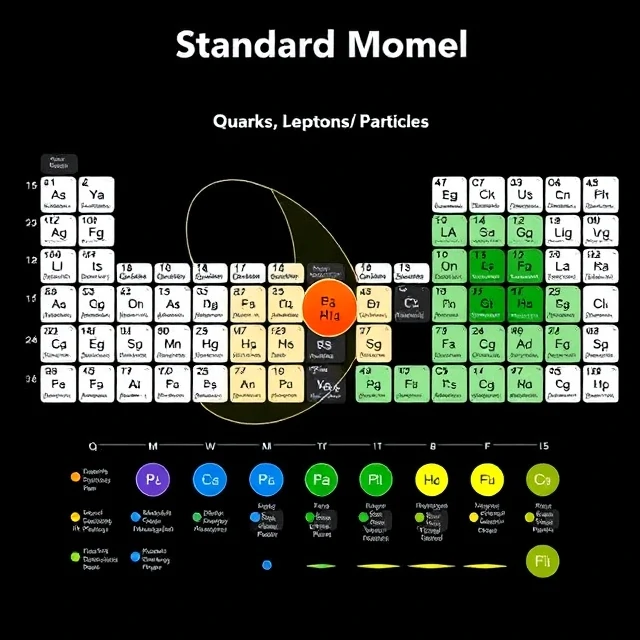
The Standard Model is the theory that describes the fundamental particles and forces of the universe, except gravity. It includes six quarks, six leptons, and four force-carrying bosons, plus the Higgs boson. It explains how quarks combine to form protons and neutrons, how electrons orbit nuclei, and how particles interact through the strong, weak, and electromagnetic forces. It is one of the most successful theories in physics, and it has passed every experimental test for decades.
The Standard Model is not complete. It does not include gravity. It does not explain dark matter or dark energy. It does not explain why the universe has more matter than antimatter. It does not explain neutrino masses, though it can accommodate them with modifications. It has 19 free parameters, like particle masses and coupling constants, that must be measured experimentally. It does not explain why those parameters have the values they do. Despite these limitations, the Standard Model is extraordinarily accurate. It predicted the existence of the W and Z bosons, the top quark, and the Higgs boson, all of which were later discovered. It is the best description we have of the subatomic world.
Standard Model particles
- Quarks. Up, down, charm, strange, top, bottom.
- Leptons. Electron, muon, tau, and neutrinos.
- Gauge bosons. Photon, gluon, W, Z.
- Higgs boson. Gives mass to particles.
- Forces. Strong, weak, electromagnetic.
The Standard Model is not the same as the standard model of cosmology. The Standard Model describes particles. The cosmological model describes the universe.
Comments
No comments yet. Be the first to share a thought.
Leave a comment