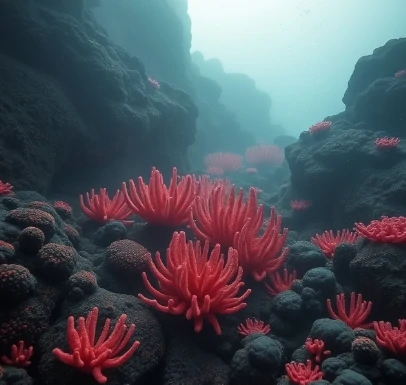
Sunlight never reaches the deep seafloor, yet dense communities of animals thrive around hydrothermal vents and cold seeps. Their ultimate energy source is chemical rather than solar. Microbes oxidize reduced compounds such as hydrogen sulfide or methane and use the released energy to build organic matter—a process called chemosynthesis.
These microbes form the base of local food webs. Some live freely in the water or sediments; others form symbiotic partnerships inside tube worms, clams, or mussels, supplying their hosts with nutrition. The discovery of chemosynthetic ecosystems in 1977 demonstrated that complex life does not require photosynthesis and expanded the known limits of habitability on Earth.
Chemosynthesis also occurs in other dark environments, including oxygen-minimum zones and deep subsurface sediments. The metabolic pathways involved are diverse and continue to yield new biochemical insights. For astrobiology, chemosynthetic systems provide models for how life might exist on worlds where sunlight is unavailable.
- Production of organic matter using chemical energy
- Powers ecosystems at vents and seeps
- Often involves symbiotic microbes
- Expands the known range of Earth’s biosphere
Comments
No comments yet. Be the first to share a thought.
Leave a comment