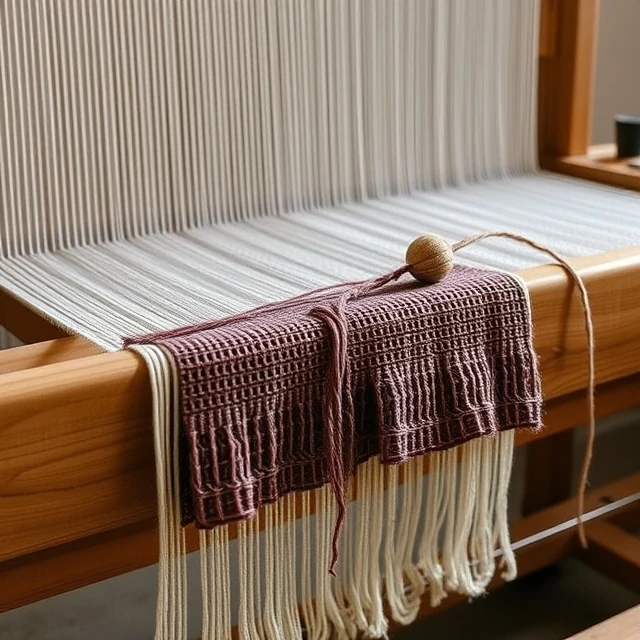
Weaving interlaces two sets of threads to make fabric. The warp threads run lengthwise under tension. The weft threads cross over and under the warp. That simple over-under pattern, repeated row after row, builds cloth. The loom holds the warp tight and helps the weaver pass the weft. Different looms suit different scales. A frame loom handles small tapestries. A floor loom handles wide yardage. A rigid heddle loom sits in between, simple enough for beginners but capable of real cloth.
The pattern comes from how the weft crosses the warp. Plain weave is over one, under one. Twill is over two, under one, which creates diagonal lines. Satin floats the weft over several warp threads, which gives a smooth, shiny surface. Color changes add further variety. Tapestry weaving uses discontinuous weft threads to build pictures, one color block at a time.
Basic weaving terms
- Warp — the lengthwise threads under tension
- Weft — the crosswise thread passed through the warp
- Shed — the opening between raised and lowered warp threads
- Shuttle — the tool that carries the weft through the shed
- Beater — the part that pushes each weft row into place
Tension is everything. Warp threads must be evenly tight. If one thread is loose, the fabric has a flaw that no amount of beating will fix.
Comments
No comments yet. Be the first to share a thought.
Leave a comment