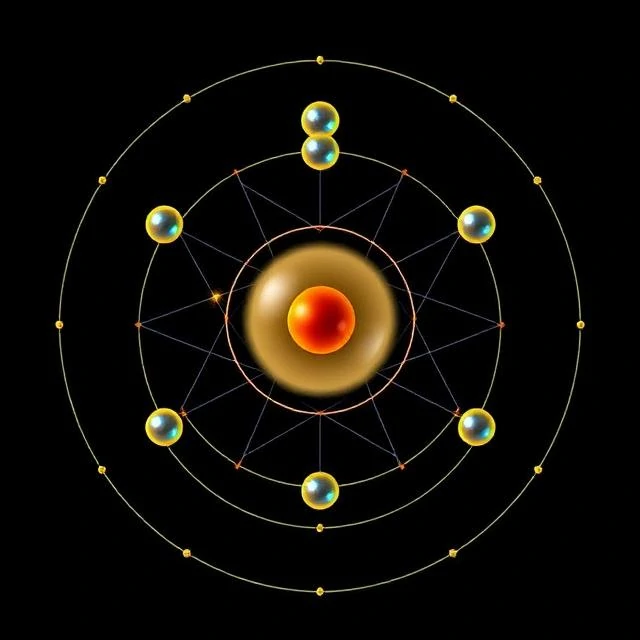
Democritus proposed the idea in ancient Greece: matter is made of tiny, indivisible particles. He called them atomos, meaning uncuttable. The idea lay dormant for two millennia until John Dalton revived it in 1803. Atoms are not indivisible. They have a nucleus of protons and neutrons surrounded by a cloud of electrons. But they are the smallest unit of an element that retains its chemical properties.
Atoms are mostly empty space. The nucleus is tiny, about 1/100,000th the diameter of the atom, but it contains almost all the mass. Protons are positively charged. Neutrons are neutral. Electrons are negatively charged and occupy orbitals around the nucleus. The number of protons determines the element. The number of neutrons determines the isotope. The number of electrons determines the charge.
Atoms combine to form compounds and molecules. They bond by sharing electrons (covalent bonds) or by transferring electrons (ionic bonds). The arrangement of electrons, especially the outermost ones, determines how an atom behaves. The periodic table organizes elements by their atomic number and electron configuration, revealing patterns in chemical behavior.
Atoms are not solid balls. They are quantum mechanical systems described by wave functions. Electrons do not orbit like planets. They exist in probability clouds. The atom is a model, and the model has evolved. It will keep evolving as we learn more.
Comments
No comments yet. Be the first to share a thought.
Leave a comment