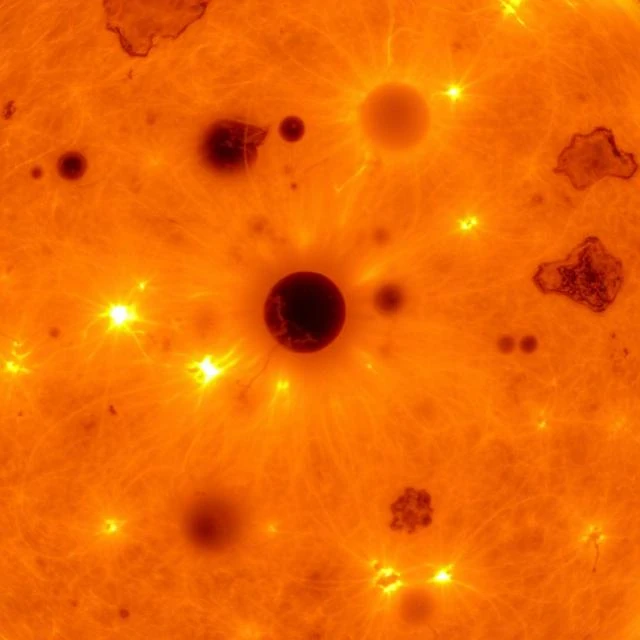
Sunspots are darker, cooler regions on the Sun's surface. They look small, but a typical sunspot is about the size of Earth. The darkness is a contrast effect. A sunspot is about 1,500 Kelvin cooler than the surrounding photosphere, so it appears dark against the brighter surface. If you could see a sunspot alone, it would glow brighter than the full Moon.
Sunspots are caused by magnetic activity. The Sun's magnetic field gets twisted by the differential rotation of its plasma. Where the field is strong, it suppresses the flow of heat from below, creating a cooler region. Sunspots often come in pairs, with opposite magnetic polarities. They are surrounded by bright areas called faculae, which are hotter and more active.
The number of sunspots rises and falls in an 11-year cycle. At solar maximum, the Sun is covered with spots and flares. At solar minimum, it is nearly spotless. The cycle affects space weather, Earth's climate, and the brightness of the Sun. The Maunder Minimum, a period of very few sunspots from 1645 to 1715, coincided with a period of global cooling called the Little Ice Age.
Galileo was the first to observe sunspots with a telescope in 1610. He showed that they were on the Sun's surface, not in the sky. That observation challenged the idea that the Sun was perfect and unchanging.
Comments (3)
Leave a comment