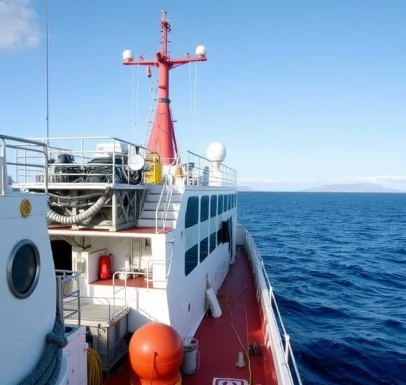
Ships designed and equipped for oceanographic science are research vessels. They carry the winches, laboratories, acoustic systems, and berthing needed to support teams of scientists at sea for weeks or months.
A typical research vessel can deploy CTDs, nets, corers, autonomous vehicles, and moorings. Laboratories allow immediate processing of samples for chemistry, biology, and geology. Dynamic positioning systems hold the ship on station even in rough seas. Some vessels are ice-strengthened for polar work; others specialize in fisheries acoustics or geophysical surveying.
Research vessels remain indispensable despite the growth of autonomous platforms, because many instruments and experiments still require human presence and heavy-lift capacity. Operating costs are high, so ship time is carefully allocated through competitive proposals. International collaboration often shares the expense of large expeditions to remote regions.
The arrival of a research vessel at a rarely visited location still marks the beginning of new discoveries.
Comments
No comments yet. Be the first to share a thought.
Leave a comment