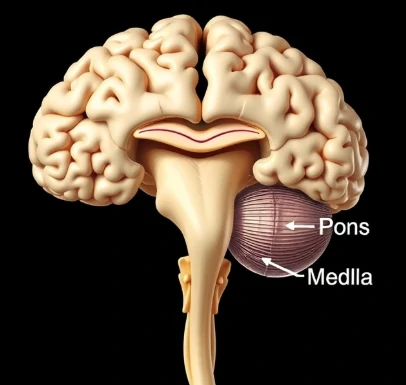
The brainstem is the stalk-like structure that connects the cerebrum and cerebellum to the spinal cord. It is the oldest part of the brain in evolutionary terms and remains essential for the most basic life functions.
Three regions make up the brainstem: the midbrain, the pons, and the medulla oblongata. Together they regulate heart rate, blood pressure, and breathing. They contain the nuclei of most cranial nerves, which control the face, mouth, and eyes, and they house the ascending and descending tracts that carry sensory and motor information between the body and the higher brain. The reticular formation within the brainstem modulates arousal and sleep-wake cycles; damage can produce coma.
Because the brainstem is densely packed with critical pathways and nuclei, even small lesions can be devastating. At the same time, its relative simplicity compared with the cortex makes it a region where certain automatic functions can continue even when higher awareness is lost.
When the heart beats and the lungs expand without conscious instruction, the brainstem is doing its continuous, unobtrusive work.
Comments
No comments yet. Be the first to share a thought.
Leave a comment