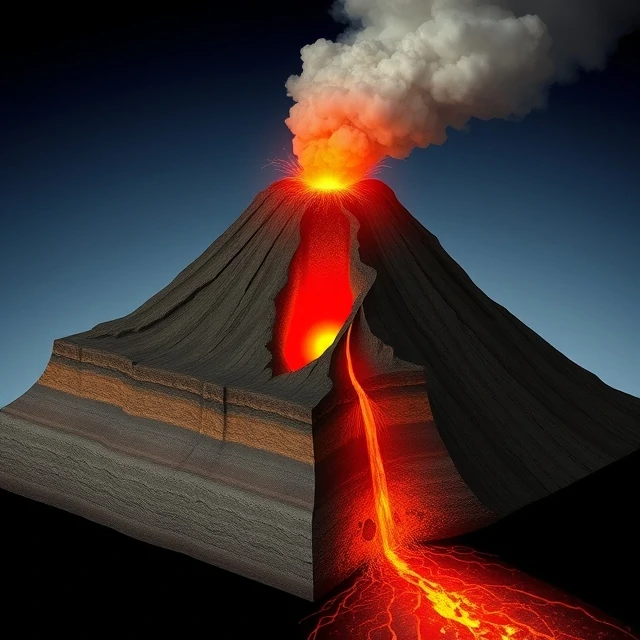
Deep beneath volcanoes and in the roots of mountain belts, rock melts to form magma. Magma is molten or partially molten rock beneath Earth’s surface. It consists of liquid silicate melt, suspended crystals, and dissolved gases.
Magma forms by partial melting of mantle or crustal rocks when temperature rises, pressure drops, or water is added. Once generated, it may stall in magma chambers, crystallize slowly to form intrusive rocks, or rise to erupt as lava. Composition evolves through crystallization and assimilation of wall rock.
The dissolved gases in magma drive explosive eruptions when they exsolve near the surface. Samples of magma trapped as melt inclusions inside crystals provide snapshots of deep processes. Understanding magma generation and movement is central to both igneous petrology and volcanic hazard assessment.
- Molten rock beneath Earth’s surface
- Contains melt, crystals, and dissolved gases
- Forms by partial melting
- Source of all igneous rocks
Comments
No comments yet. Be the first to share a thought.
Leave a comment