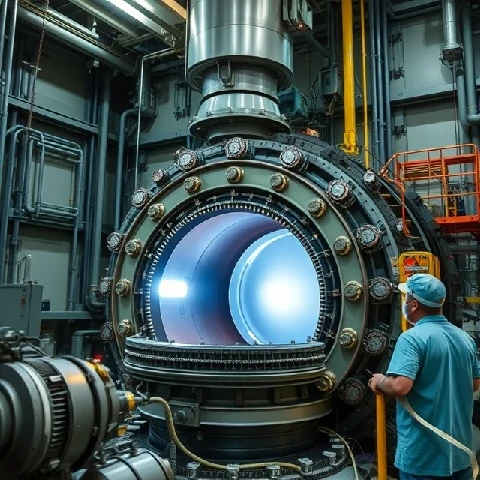
Nuclear fission splits a heavy atom into lighter ones. When a neutron hits a uranium-235 nucleus, the nucleus absorbs it and becomes unstable. It splits, releasing energy, more neutrons, and lighter elements. Those neutrons can trigger more splits, creating a chain reaction.
The energy released is enormous. Splitting one kilogram of uranium-235 releases about 24 million kilowatt-hours of heat. Burning one kilogram of coal releases about 8 kilowatt-hours. That ratio explains why nuclear fuel is so compact and why reactors need so little of it.
Controlling the chain reaction is the engineering challenge. Control rods absorb neutrons and slow the reaction. Moderators slow neutrons so they are more likely to split nuclei. Coolant carries heat away to make steam. If control is lost, the reaction can accelerate dangerously, as happened at Chernobyl in 1986.
Key concepts
- Chain reaction
- Critical mass
- Control rods
- Moderator
- Enrichment
Comments
No comments yet. Be the first to share a thought.
Leave a comment