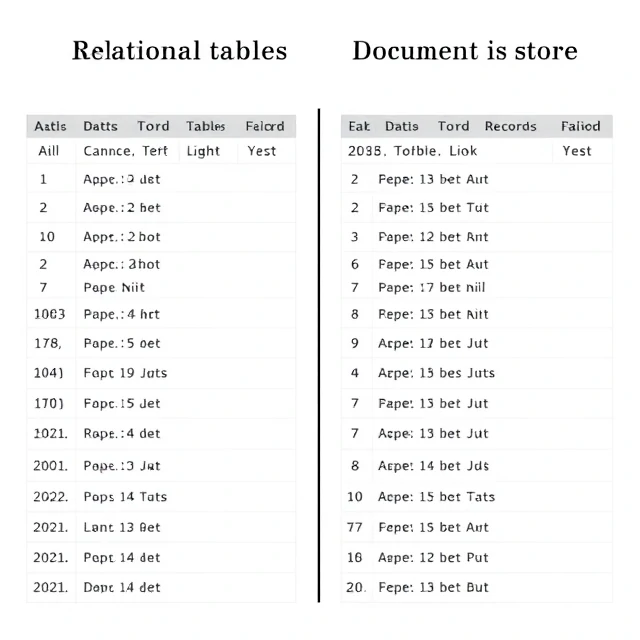
NoSQL databases do not use the relational table model. The category covers document stores, key-value stores, graph databases, and wide-column stores. Each solves a different problem. Document stores like MongoDB keep JSON-like records. Key-value stores like Redis map keys to values for fast lookups. Graph databases like Neo4j model relationships between entities. Wide-column stores like Cassandra handle massive write volumes across distributed nodes. The common thread is flexibility. NoSQL databases relax schema constraints that relational databases enforce.
That flexibility is the appeal and the risk. A document store accepts records with different fields. That makes it easy to evolve the data model without migrations. It also makes it easy to create inconsistent data. The application must enforce the rules that the database does not. NoSQL databases also scale horizontally more easily than traditional relational systems. They distribute data across many servers, which handles high traffic and large datasets. The trade-off is consistency. Many NoSQL databases offer eventual consistency rather than strong consistency. Different nodes may see different values for a short time. That is acceptable for a social media feed. It is not acceptable for a bank balance. The right choice depends on the data and the guarantees the application needs.
NoSQL database types
- Document — JSON-like records, flexible schema
- Key-value — simple pairs, fast lookups
- Graph — nodes and relationships
- Wide-column — distributed, high write throughput
- Time-series — optimized for timestamped data
NoSQL is not better than SQL. It is different. The right tool depends on the problem.
Comments
No comments yet. Be the first to share a thought.
Leave a comment