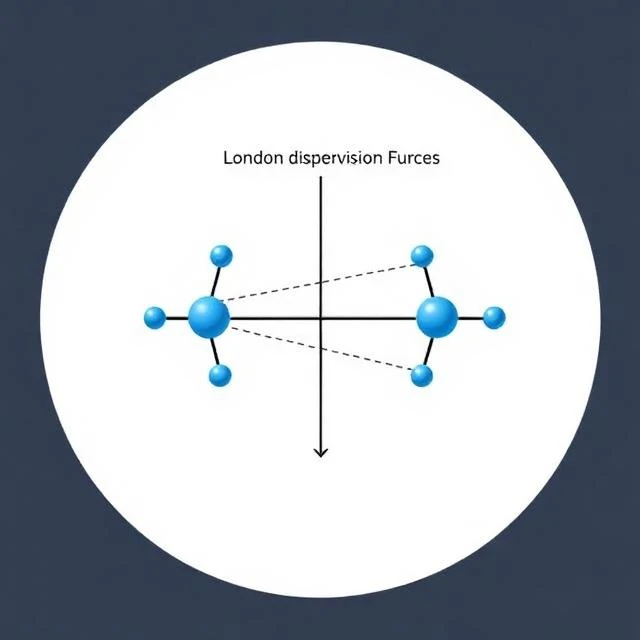
Molecules attract each other even when they are not bonded. These weak attractions are called Van der Waals forces, named after Johannes Diderik van der Waals, who described them in the 19th century. They include dipole-dipole interactions, dipole-induced dipole interactions, and London dispersion forces. They are weaker than covalent or ionic bonds, but they determine boiling points, melting points, and the physical properties of many substances.
London dispersion forces are the weakest and most universal. They arise from temporary fluctuations in electron density that create instantaneous dipoles. These dipoles induce dipoles in nearby molecules, creating a weak attraction. Dispersion forces increase with molecular size and surface area. That is why larger molecules have higher boiling points. Iodine is a solid at room temperature, while fluorine is a gas. Both are halogens, but iodine has more electrons and stronger dispersion forces.
Dipole-dipole interactions occur between polar molecules. The partial positive end of one molecule attracts the partial negative end of another. Hydrogen bonds are a special, stronger case of dipole-dipole interaction. They occur when hydrogen is bonded to nitrogen, oxygen, or fluorine. They are responsible for water's high boiling point and DNA's double helix.
Van der Waals forces are important in biology, materials science, and chemistry. They hold together the layers of graphite, allow geckos to climb walls, and determine how drugs bind to their targets. They are weak individually, but collectively they are powerful.
Comments
No comments yet. Be the first to share a thought.
Leave a comment